


Page 195 - The City and Guilds Textbook: Plumbing Book 1 for the Level 3 Apprenticeship (9189), Level 2 Technical Certificate (8202) and Level 2 Diploma (6035)
P. 195
Chapter 3 Scientific principles
The same can apply for unequal forces. They, too, can be in a state of equilibrium
provided left and right forces are equal but not necessarily the same as the equal
up and down forces.
The key word here is balanced. All forces, whether equal or not, must be
balanced. The forces cancel each other out and so add up to zero. In other
words, for an object to be in equilibrium, the sum of the forces on each part
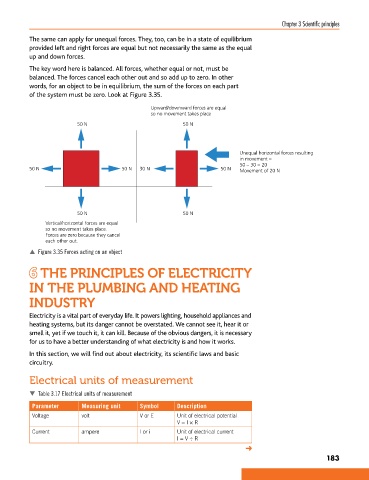
of the system must be zero. Look at Figure 3.35.
Upward/downward forces are equal
so no movement takes place
50 N 50 N
Unequal horizontal forces resulting
in movement =
50 – 30 = 20
50 N 50 N 30 N 50 N Movement of 20 N
50 N 50 N
Vertical/horizontal forces are equal
so no movement takes place.
Forces are zero because they cancel
each other out.
p Figure 3.35 Forces acting on an object
6 THE PRINCIPLES OF ELECTRICITY
IN THE PLUMBING AND HEATING
INDUSTRY
Electricity is a vital part of everyday life. It powers lighting, household appliances and
heating systems, but its danger cannot be overstated. We cannot see it, hear it or
smell it, yet if we touch it, it can kill. Because of the obvious dangers, it is necessary
for us to have a better understanding of what electricity is and how it works.
In this section, we will find out about electricity, its scientific laws and basic
circuitry.
Electrical units of measurement
Table 3.17 Electrical units of measurement
Parameter Measuring unit Symbol Description
Voltage volt V or E Unit of electrical potential
V = I × R
Current ampere I or i Unit of electrical current
I = V ÷ R
➜
183
9781510416482.indb 183 29/03/19 8:55 PM

