


Page 240 - The City and Guilds Textbook: Plumbing Book 1 for the Level 3 Apprenticeship (9189), Level 2 Technical Certificate (8202) and Level 2 Diploma (6035)
P. 240
The City & Guilds Textbook: Plumbing Book 1


                                            responsible for completing the risk assessment, they must know how to follow
                                            it and be aware of its purpose. The law does not expect all risks to be eliminated
                                            but there is a requirement to protect people as far as is reasonably practicable.

                                            As well as complying with the law, a risk assessment enables a worker to focus on
                                            those risks in the workplace with the potential to cause real harm. Straightforward
                                            measures can usually control risks, such as making sure that spillages are cleaned
                                            up quickly to help prevent the apprentice from slipping. Untidy work areas can also
                                            lead to accidents caused by people tripping over pipework and leads. Accidents
                                            and ill health can seriously affect lives and have a negative impact on business,
                                            especially as a result of court action. Therefore, there is a legal requirement to
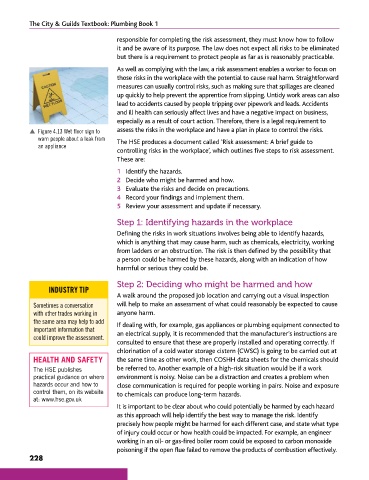
                p  Figure 4.13 Wet floor sign to   assess the risks in the workplace and have a plan in place to control the risks.
                   warn people about a leak from   The HSE produces a document called ‘Risk assessment: A brief guide to
                   an appliance
                                            controlling risks in the workplace’, which outlines five steps to risk assessment.
                                            These are:
                                            1  Identify the hazards.
                                            2  Decide who might be harmed and how.
                                            3  Evaluate the risks and decide on precautions.
                                            4  Record your findings and implement them.
                                            5  Review your assessment and update if necessary.

                                            Step 1: Identifying hazards in the workplace

                                            Defining the risks in work situations involves being able to identify hazards,
                                            which is anything that may cause harm, such as chemicals, electricity, working
                                            from ladders or an obstruction. The risk is then defined by the possibility that
                                            a person could be harmed by these hazards, along with an indication of how
                                            harmful or serious they could be.

                                            Step 2: Deciding who might be harmed and how
                      INDUSTRY TIP
                                            A walk around the proposed job location and carrying out a visual inspection
                 Sometimes a conversation   will help to make an assessment of what could reasonably be expected to cause
                 with other trades working in   anyone harm.
                 the same area may help to add   If dealing with, for example, gas appliances or plumbing equipment connected to
                 important information that   an electrical supply, it is recommended that the manufacturer’s instructions are
                 could improve the assessment.
                                            consulted to ensure that these are properly installed and operating correctly. If
                                            chlorination of a cold water storage cistern (CWSC) is going to be carried out at
                 HEALTH AND SAFETY          the same time as other work, then COSHH data sheets for the chemicals should
                 The HSE publishes          be referred to. Another example of a high-risk situation would be if a work
                 practical guidance on where   environment is noisy. Noise can be a distraction and creates a problem when
                 hazards occur and how to   close communication is required for people working in pairs. Noise and exposure
                 control them, on its website   to chemicals can produce long-term hazards.
                 at: www.hse.gov.uk
                                            It is important to be clear about who could potentially be harmed by each hazard
                                            as this approach will help identify the best way to manage the risk. Identify
                                            precisely how people might be harmed for each different case, and state what type
                                            of injury could occur or how health could be impacted. For example, an engineer
                                            working in an oil- or gas-fired boiler room could be exposed to carbon monoxide
                                            poisoning if the open flue failed to remove the products of combustion effectively.
                228


        9781510416482.indb   228                                                                                    29/03/19   8:56 PM

