


Page 245 - The City and Guilds Textbook: Plumbing Book 1 for the Level 3 Apprenticeship (9189), Level 2 Technical Certificate (8202) and Level 2 Diploma (6035)
P. 245
General Risk Assessment Form
                 Location: Boiler room no 2, Looming Towers, Scare Street, Wick, UK
                 Environment/Activity/Equipment Live. Tightness testing and purging of gas installation in boiler room.
                 Who is at risk:
                              plumbers
                                        Leading to a risk of
                                                            Existing measures to
                                                                                      Risk rating
                   Hazard/s
                                                                                                   Action required
                                                            control risk
                                                                                                   Yes/No
                                                                                                   Ref No
                                                                                         S
                                        Gas in air
                   Gas leakage
                                                                                         1
                                                                                               1
                                                                                                   no
                                                            System tested before use
                                                            Apprentices monitored and
                                                            supervised
                                                            System tested after any
                                                            alteration
                                                                                               6
                                                            Sectioning off areas
                                        Gas in air / LEL lower
                                                                                         3
                   Purging of gas
                                        Explosive Limit
                                                                                                   yes
                                                            No naked flames or switching /
                                                            unless intrinsically safe (IS)
                 If young apprentices will be involved with this gas testing equipment, have the following been considered in the assessment:
                 Is the installation work required as part of their on site training? Y / N; The need to be supervised by a competent person Y / N; Their lack of experience
                 Y / N; If new to work, their lack of awareness of workplace risks Y / N; Their gender Y / N; Their manual dexterity Y / N; Their physical abilities Y / N.
                                                              Action plan
                   Ref
                        Further action required
                                                                      Action by whom
                                                                                                  Date completed
                                                                                      when
                   No
                   1
                                                                      Supervisor /
                        Only persons deemed safe, responsible and conscientious will be
                                                                                      Immediate
                        allowed to touch the equipment even if supervised.
                                                                      Foreman
                                                                                      effect
                   2
                                                                                      Immediate
                                                                      Senior gas
                        Use of gas co seeker to search leaks plus leak detection fluid.
                                                                      engineer/ Plumber
                                                                                      effect
                                                                                      Immediate
                        Whole system to be commissioned after successful completion
                   3
                                                                      Senior gas
                        of documentation.
                                                                      engineer/ Plumber
                                                                                      effect
                 Sign off procedure    public   contractors   others (state) ................................  1 2 L  Action by   RR  Company Sector: Plumbing
                 Work Completed by:    Signature .....................................   Name .....................................   Date .....................
                 Checked by Supervisor:   Signature .....................................   Name .....................................   Date .....................
                 Approved By           Signature .....................................   Name .....................................   Date .....................
                                                                                              Chapter 4 Planning and supervision
                 Risk Number .................   Signature .....................................   Name .....................................   Date .....................
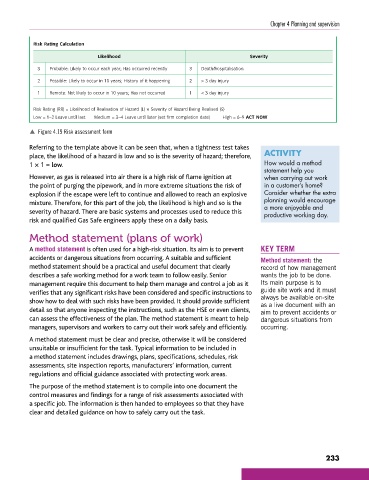
                 Risk Rating Calculation
                                      Likelihood                                       Severity
                   3  Probable: Likely to occur each year; Has occurred recently  3  Death/hospitalisation
                   2  Possible: Likely to occur in 10 years; History of it happening  2  > 3 day injury
                   1  Remote: Not likely to occur in 10 years; Has not occurred  1  < 3 day injury
                 Risk Rating (RR) = Likelihood of Realisation of Hazard (L) × Severity of Hazard Being Realised (S)
                 Low = 1–2 Leave until last   Medium = 3–4 Leave until later (set firm completion date)   High = 6–9 ACT NOW
                p  Figure 4.19 Risk assessment form
                Referring to the template above it can be seen that, when a tightness test takes
                place, the likelihood of a hazard is low and so is the severity of hazard; therefore,   ACTIVITY
                1 × 1 = low.                                                                How would a method
                                                                                            statement help you
                However, as gas is released into air there is a high risk of flame ignition at   when carrying out work
                the point of purging the pipework, and in more extreme situations the risk of   in a customer’s home?
                explosion if the escape were left to continue and allowed to reach an explosive   Consider whether the extra
                mixture. Therefore, for this part of the job, the likelihood is high and so is the   planning would encourage
                severity of hazard. There are basic systems and processes used to reduce this   a more enjoyable and
                                                                                            productive working day.
                risk and qualified Gas Safe engineers apply these on a daily basis.
                Method statement (plans of work)
                A method statement is often used for a high-risk situation. Its aim is to prevent   KEY TERM
                accidents or dangerous situations from occurring. A suitable and sufficient   Method statement: the
                method statement should be a practical and useful document that clearly    record of how management
                describes a safe working method for a work team to follow easily. Senior   wants the job to be done.
                management require this document to help them manage and control a job as it   Its main purpose is to
                verifies that any significant risks have been considered and specific instructions to   guide site work and it must
                show how to deal with such risks have been provided. It should provide sufficient   always be available on-site
                                                                                           as a live document with an
                detail so that anyone inspecting the instructions, such as the HSE or even clients,   aim to prevent accidents or
                can assess the effectiveness of the plan. The method statement is meant to help   dangerous situations from
                managers, supervisors and workers to carry out their work safely and efficiently.  occurring.
                A method statement must be clear and precise, otherwise it will be considered
                unsuitable or insufficient for the task. Typical information to be included in
                a method statement includes drawings, plans, specifications, schedules, risk
                assessments, site inspection reports, manufacturers’ information, current
                regulations and official guidance associated with protecting work areas.
                The purpose of the method statement is to compile into one document the
                control measures and findings for a range of risk assessments associated with
                a specific job. The information is then handed to employees so that they have
                clear and detailed guidance on how to safely carry out the task.
                                                                                                                233
        9781510416482.indb   233                                                                                    29/03/19   8:56 PM

