


Page 241 - The City and Guilds Textbook: Plumbing Book 1 for the Level 3 Apprenticeship (9189), Level 2 Technical Certificate (8202) and Level 2 Diploma (6035)
P. 241
Chapter 4 Planning and supervision


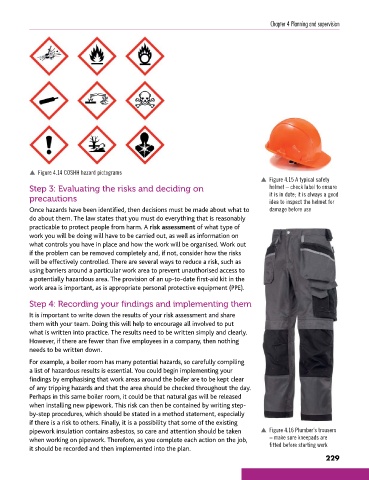
                p  Figure 4.14 COSHH hazard pictograms
                                                                                           p  Figure 4.15 A typical safety
                Step 3: Evaluating the risks and deciding on                                  helmet – check label to ensure
                precautions                                                                   it is in date; it is always a good
                                                                                              idea to inspect the helmet for
                Once hazards have been identified, then decisions must be made about what to   damage before use
                do about them. The law states that you must do everything that is reasonably
                practicable to protect people from harm. A risk assessment of what type of
                work you will be doing will have to be carried out, as well as information on
                what controls you have in place and how the work will be organised. Work out
                if the problem can be removed completely and, if not, consider how the risks
                will be effectively controlled. There are several ways to reduce a risk, such as
                using barriers around a particular work area to prevent unauthorised access to
                a potentially hazardous area. The provision of an up-to-date first-aid kit in the
                work area is important, as is appropriate personal protective equipment (PPE).

                Step 4: Recording your findings and implementing them
                It is important to write down the results of your risk assessment and share
                them with your team. Doing this will help to encourage all involved to put
                what is written into practice. The results need to be written simply and clearly.
                However, if there are fewer than five employees in a company, then nothing
                needs to be written down.

                For example, a boiler room has many potential hazards, so carefully compiling
                a list of hazardous results is essential. You could begin implementing your
                findings by emphasising that work areas around the boiler are to be kept clear
                of any tripping hazards and that the area should be checked throughout the day.
                Perhaps in this same boiler room, it could be that natural gas will be released
                when installing new pipework. This risk can then be contained by writing step-
                by-step procedures, which should be stated in a method statement, especially
                if there is a risk to others. Finally, it is a possibility that some of the existing
                pipework insulation contains asbestos, so care and attention should be taken   p  Figure 4.16 Plumber’s trousers
                when working on pipework. Therefore, as you complete each action on the job,   – make sure kneepads are
                it should be recorded and then implemented into the plan.                     fitted before starting work
                                                                                                                229


        9781510416482.indb   229                                                                                    29/03/19   8:56 PM

