


Page 106 - APPLIED PROCESS DESIGN FOR CHEMICAL AND PETROCHEMICAL PLANTS, Volume 1, 3rd Edition
P. 106
90                       Applied Process Design for Chemical  and Petrochemical  Plants

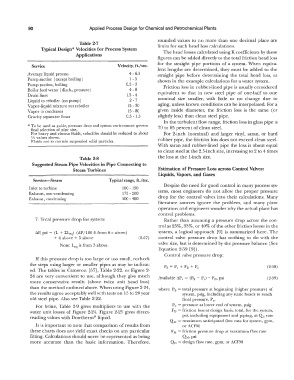
                                                                   rounded values  to  no  more  than  one  decimal  place  are
                                  Table 2-7                        limits for such head loss calculations.
                  Typical Design* Velocities for Process System      The head losses calculated using K coefficients by these
                                 Applications
                                                                   figures can be added directly to the total friction head loss
                                                                   for the  straight pipe  portions  of a system.  When  equiva-
              Service                             Velocity, ft./sec.
                                                                   lent lengths  are  determined,  they  must be  added  to  the
             Average liquid process                    4 - 6.5     straight pipe  before  determining  the  total  head  loss,  as
             Pump suction ( except boiling)            1  - 5      shown in the example calculations for a water system.
             Pump suction, boiling                    0.5 - 3
             Boiler feed water ( disch., pressure)     4-8           Friction loss in rubber-lined pipe is usually considered
             Drain lines                              1.5 - 4      equivalent  to  that  in  new  steel  pipe  of one-half to  one
             Liquid to re boiler ( no pump)            2-7         nominal  size  smaller,  with  little  or  no  change  due  to
             Vapor-liquid mixture out reboiler        15 - 30      aging, unless known conditions can be interpolated. For a
             Vapor to condenser                        15 - 80     given  inside  diameter,  the  friction  loss  is  the  same  ( or
             Gravity separator flows                  0.5 -  1.5   slightly less)  than clean steel pipe.
                                                                     ln the turbulent flow range, friction loss in glass pipe is
             *Tobe used  as  guide, pressure drop and system environment govern
              final selection of pipe  size.                       70 to 85  percent of clean steel.
              For heavy and viscous  fluids, velocities  should be reduced to about   For 2-inch  (nominal)  and  larger vinyl,  saran,  or hard
              Y2  values shown.
              Fluids  not to  contain suspended solid particles.   rubber pipe,  the friction loss does not exceed clean steel.
                                                                   With saran  and rubber-lined  pipe  the loss  is about equal
                                                                   to clean steel at the 2.5-inch size, increasing to 2 to 4 times
                                  Table 2-8                        the loss at the  1-inch size.
              Suggested Steam Pipe Velocities in Pipe Connecting to
                                Steam Turbines                     Estimation of Pressure Loss across Control Valves:
                                                                   Liquids, Vapors,  and Gases
               Service-Steam                  Typical range,  h./sec.
                                                                      Despite the need for good control in many process sys-
             Inlet to turbine                       100 -  150
             Exhaust, non-condensing                175 - 200      tems,  most engineers  do  not allow  the  proper  pressure
             Exhaust, condensing                    500 - 400      drop  for the  control  valves  into  their calculations.  Many
                                                                   literature  sources  ignore  the  problem,  and  many  plant
                                                                   operators  and engineers wonder why the actual plant has
                                                                   control  problems.
                7. Total  pressure drop for system:                   Rather than  assuming a  pressure drop across  the con-
                                                                   trol as 25%, 33%, or 40% of the other friction losses in the
                t.P,  psi= (L +  I:Leql  (t.P/100 ft from 6 c above)   system,  a  logical  approach  [9]  is  summarized  here.  The
                        +  4 above +  5 above              (2-57)   control  valve  pressure  drop  has  nothing  to  do  with  the

                          Note:  L 0 q  is from 3 above.           valve size, but is determined by the pressure balance (See
                                                                   Equation 2-59  [9]).
                                                                      Control valve  pressure drop:
                If this  pressure  drop is  too large or too small,  recheck
              the steps  using larger or smaller pipes as  may be indicat-                                       (2-58)
             ed.  The tables  in Cameron  [57], Table 2-22, or Figure  2-
              24  are very convenient to  use,  although  they give  much   Available Af'c  =  (Ps  - P cl - Fo,  psi   (2-59)
              more  conservative  results  (about  twice  unit  head  loss)
              than the method outlined above. When using Figure 2-24,   where  Ps  =  total pressure at beginning (higher pressure)  of
              the results agree acceptably well with tests on 15 to 20 year   system,  psig,  including any static heads to reach
              old steel  pipe.  Also see Table 2-22.                         final pressure, P 0•
                For  brine,  Table  2-9  gives  multipliers  to  use  with  the   Pe  =  pressure at lower end of system, psig
              water unit losses  of Figure  2-24.  Figure  2-25  gives  direct-   F 0  =  friction loss at design basis,  total, for the system,
              reading values with Dowtherm®  liquid.                         psi, including equipment and piping,  at Q 0  rate
                                                                        Q� 1  =  maximum anticipated flow rate for system, gpm,
                It is important to note  that comparison of results from     orACFM
              these charts does not yield exact checks on any particular   F� 1  = friction pressure drop at maximum flow rate
              fitting.  Calculations should never be represented as being    Q\1, psi
              more  accurate  than  the  basic  information.  Therefore,   Q 0  = design flow rate, gpm, or ACFM

