


Page 276 - APPLIED PROCESS DESIGN FOR CHEMICAL AND PETROCHEMICAL PLANTS, Volume 1, 3rd Edition
P. 276
246                       Applied Process Design for Chemical  and Petrochemical  Plants

                    D""'tcr =  4(5.01)/[2.828  + 27t  (1.5)  - 3.69)  =  2.34ft   There  are  basically  three  construction  types  for
                                                                  impingement separators:
                     "water= 0.187/5.01  =  0.0373ft/sec
                                                                     1. Wire mesh
                 N       =  (0.0373)  (2.34)  (62.3)  =   ll, 399
                   Re  (water)   4.77  X  10-,j                      2. Plates  ( curved, flat or special shaped)
                                                                     3. Packed Impingement Beds
                       d  =  droplet diameter,  ft.
                                                                   Knitted Wire Nlesh
               The degree of  turbulence would be classified as accept-
             able,  but the  unit must not be  increased  in  capacity  for   A stationary separator element of knitted small  diame-
             fear of creating more water phase turbulence.         ter wire  or plastic  material  is formed of wire 0.003  in.  to
                                                                   0.016 in.  (or larger)  diameter into  a  pad  of 4  inches,  6
                                                                  inches or 12 inches  thick and serves  as  the impingement
             B. Impingement Separators
                                                                  surface for liquid particle  separation.  Solid particles  can
                                                                   be separated,  but they must be flushed from the mesh  to
               As  the  descriptive  name  suggests,  the  impingement   prevent plugging.  Although  several  trade name units are
             separator  allows  the  particles  to  be  removed  to  strike   available  they  basically  perform  on  the  same  principle,
             some  type  of surface.  This  action is  better accomplished   and have very close physical characteristics. Carpenter [ 4]
             in pressure systems where pressure drop can be taken as a   presented basic performance data for mesh units.  Figure
             result of the  turbulence which  necessarily  accompanies   4-15 shows a  typical eliminator pad.
             the removal action.
                                                                     Figure  4-16  pictorially  depicts  the  action  of the  wire
               Particle removal in streamline flow is less efficient than   mesh when placed in a vertical vessel.
             for turbulent flow,  and may not be effective if the path of   Referring  to  Figure  4-16,  the  typical  situation  repre-
             travel is not well baffled.                           sents  a vapor disengaging from a liquid by bursting bub-
               The  "target" efficiency for impingement units express-   bles  and  creating  a  spray  of liquid  particles  of various
             es  the  fraction  of the  particles  in  the  entraining  fluid,   sizes.  Many of these particles are entrained in the moving
             moving past an object in the fluid, which impinge on the   vapor stream. The largest and heaviest particles will settle
             object.                                               by gravity  downward through  the stream and back  to  the
                                                                   bottom of the vessel or to the liquid surface. The smaller
               The  target efficiencies for cylinders,  spheres,  and rib--
             bonlike particles are given for conditions of Stokes Law in   particles  move  upward,  and  if  not  removed  will  carry
                                                                   along in  the process  stream.  With wire  mesh in the mov-
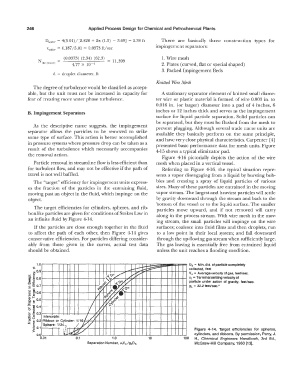
             an infinite fluid by Figure  4-14.
                                                                   ing stream,  the small  particles  will  impinge  on  the wire
               If the  particles  are  close  enough  together in  the fluid   surfaces;  coalesce into fluid films and then droplets,  run
             to  affect the  path  of each  other,  then  Figure  1-11 gives   to  a  low  point  in  their  local  system;  and  fall  downward
             conservative efficiencies.  For particles differing consider-   through the up-fl.owing gas stream when sufficiently large.
             ably  from  those  given  in  the  curves,  actual  test  data   The  gas  leaving is  essentially free from  entrained  liquid
             should be obtained.                                   unless the unit reaches a flooding condition.


                1.0                                                             Db  =  Min. dla. of particle completely
               ;;.                                        ....   i--  � ::;.---   collected,  feet
               ,;..0.9                                  -  ...                  VO =  Average velocity of gas, feet/sec.
                                                          ,....
             -  <>  c:                       �y  /  -'.'.'.                     u, =  Terminal settling velocity of
             Q.
             a>  .!!1  0.8
                                                 I  <>yy'
             3:  .2
                                            o�
             Cl)  :t:                     Q;-1  �0·                             particle  under action  of gravity,  feet/sec.
                                                                                gL = 32.2 feet/sec.•
             c:  w  0.7
             �m                                     � <>
             .£  � 0.6
             �  I-                       I  �Q  �0   b0  s;  •
             �  c:  0.5
             ..  0                     I    .1Vcf�
             �  j0.4
             O  t,                    I   1/V
                                      .:
             5 s 0.3
             --  0   Intercepts:    j    /
             �  �  0.2  Ribbon  or Cylinder:  1/ �
             u..  E   Sphere:  1/241   /   /
               �   0.1                                                             Figure  4-14.  Target  efficiencies  for  spheres,
               >            Ii 1kZ/
                o.o                                                               cylinders,  and ribbons.  By permission, Perry,  J.
                  0.01           0.1            1.0            10             100   H.,  Chemical  Engineers  Handbook,  3rd  Ed.,
                                      Separation Number, utV  O  /gLDb             McGraw-Hill Company,  1950  [13].

