


Page 280 - APPLIED PROCESS DESIGN FOR CHEMICAL AND PETROCHEMICAL PLANTS, Volume 1, 3rd Edition
P. 280
250                       Applied Process Design for Chemical and Petrochemical  Plants

             liquids  and  systems  with  very  bad  fouling  conditions.
             Table  4-11  indicates  the  effect of disengaging  height on
              the  allowable  k  value.  Similar  relations  should  hold  for
              other mesh densities.
                                                                                          Low  Density  or
              Velocity Limitations                                    �100   ,            High  Through-Put Mesh,
                                                                      c
                                                                                                          �  ��
                                                                      Cl)
                Very  low velocities will  allow  particles  to  drift  through   -       Standard  Mesh-      \
                                                                      �  80
              the mesh and be carried out with  the leaving vapor.  Also,
             very  high  velocities  will  carry  liquid  to  the  top  of the   LL.I
                                                                      c  60
              mesh,  establish  a  "flooding"  condition,  and  then  re-   Cl>
                                                                      (.)
              entrain  the liquid from the surface of the mesh. For most   cf  40
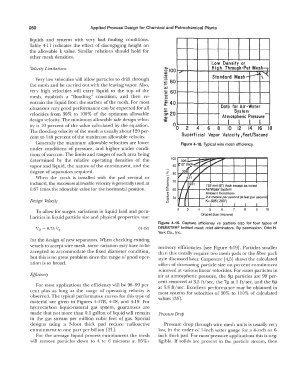
              situations very good performance can be expected for all   -                    Data  for Air-Water
                                                                                                    System
             velocities  from  30%  to  100%  of the  optimum  allowable   �20                Atmospheric  Pressure -
                                                                      Cl>
              design velocity.  The minimum allowable safe design veloc-   3:                    I   I    I   I
              ity  is  10  percent of the value calculated  by  the  equation.   2   4   6   8   10   12   14   16   18
              The flooding velocity of the mesh is usually about 120 per-    Superficia I  Vapor  Velocity,  Feet/Second
              cent to 140 percent of the maximum allowable velocity.
                Generally  the maximum allowable velocities are lower        Figure 4-18.  Typical wire mesh  efficiency.
              under conditions  of pressure,  and  higher  under  condi-
              tions of  vacuum. The limits and ranges of  each area being
              determined  by  the  relative  operating  densities  of  the   100
              vapor and liquid,  the nature of the entrainment,  and the   90
              degree of separation required.                           �  BO
                When  the  mesh  is  installed  with  the  pad  vertical  or   >,
                                                                       o
                                                                       c
              inclined, the maximum allowable velocity is generally used at   ·c:;   70   153 mm (6") thick except as noted
                                                                       Q)
              0.67 times the allowable value for the horizontal  position.   i:   60  -----+--Air/Water System
                                                                       UJ
                                                                       �               Ambient Conditions
                                                                       ::,
                                                                       1i  50  ..,...-..,1---+--  2.4 meters per second (8 feet per second
                                                                       "'
              Design  Velocity                                         o               K=.085 (.280")
                To  allow for surges,  variations in liquid load and pecu-   2   3   4   5    6    7    8    9   10
              liarities in liquid particle size and physical properties, use:         Droplet Size (microns)
                                                                   Figure  4-19.  Capture  efficiency  vs  particle  size  for four types  of
                V 0  =  0.75 V,,                           ( 4-48)   DEMISTER®  knitted mesh  mist eliminators.  By permission,  Otto  H.
                                                                   York Co.,  Inc.
              for the design of new separators.  When checking existing
              vessels to accept wire mesh, some variation may have to be   recovery  efficiencies  [see  Figure  4-19].  Particles  smaller
              accepted  to  accommodate  the fixed diameter condition,   than  this  usually require  two mesh pads or the fiber pack
              but this is no great problem since the range of good oper-   style discussed later.  Carpenter [ 4,5]  shows  the calculated
              ation  is so broad.                                   effect of decreasing particle size on percent entrainment
                                                                    removed at various linear velocities.  For water particles in
              Efficiency                                            air at atmospheric  pressure,  the  8µ  particles  are  99  per-
                                                                    cent removed at 3.5  ft/sec,  the 7µ al 5  ft/sec,  and the 6µ
                For most applications  the efficiency will  be 98-99  per-   at 6.8 ft/sec.  Excellent performance may  be obtained in
              cent  plus  as  long  as  the  range  of operating  velocity  is   most systems for velocities  of 30%  to  110%  of calculated
              observed. The typical  performance curves for this type of   values  [35].
              material  are  given  in  Figures  4-l  7B,  4-18,  and  4-19.  For
              hydrocarbon  liquid-natural  gas  system,  guarantees  are
              made that not more  than 0.1  gallon of liquid will  remain   Pressure Drop
              in  the  gas  stream  per  million  cubic  feet of gas.  Special
              designs  using  a  3-foot  thick  pad  reduce  radioactive   Pressure  drop  through  wire  mesh  units  is  usually  very
              entrainment to one part per billion  [21].            low,  in  the order of I-inch water gauge  for a 4-inch or 6-
                For the  average  liquid  process  entrainment the  mesh   inch thick pad.  For most pressure applications this is neg-
              will  remove  particles  down  to  4  to  6  microns  al  95%+   ligible.  If solids  are  present in  the  particle  stream,  then

