


Page 277 - APPLIED PROCESS DESIGN FOR CHEMICAL AND PETROCHEMICAL PLANTS, Volume 1, 3rd Edition
P. 277
Mechanical Separations                                     247


                                                                         s    r r r r r 1 r r r


                                                                         4
                                                                         3
                                                                         2


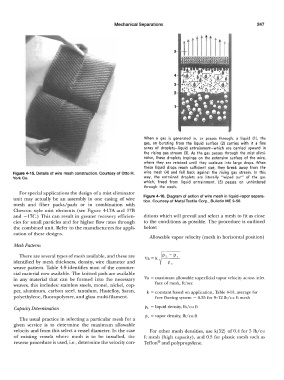
                                                            When  a  gas  is  generated  in,  or  passes  through,  a  liquid  (1),  the
                                                            gas,  on  bursting  from  the  liquid  surface  (2)  carries  with  it  a  fine
                                                            spray  of  droplets-liquid  entrainment-which  are  carried  upward  in
                                                            the  rising  gas  stream  (3).  As  the  gas  passes  through  the  mist  elimi-
                                                            nator,  these  droplets  impinge  on  the  extensive  surface  of  the  wire,
                                                            where  they  are  retained  until  they  coalesce  into  large  drops.  When
                                                            these  liquid  drops  reach  sufficient  size,  they  break  away  from  the
       Figure 4-15.  Details of wire  mesh construction.  Courtesy of Otto H.   wire  mesh  (4)  and  fall  back  against  the  rising  gas  stream.  In  this
      York Co.                                              way,  the  entrained  droplets  are  literally  "wiped  out"  of  the  gas
                                                            which,  freed  from  liquid  entrainment,  (5)  passes  on  unhindered
                                                            through  the  mesh.
         For special applications the design of a mist eliminator
       unit may  actually  be  an  assembly  in  one  casing  of wire   Figure 4-16.  Diagram of action of wire mesh in liquid-vapor separa-
                                                            tion. Courtesy of Metal Textile Corp., Bulletin ME 9-58.
       mesh  and  fiber  packs/pads  or  in  combination  with
       Chevron  style  mist elements  (see  Figure  4-l 7A  and  17B
       and  -17C.)  This  can  result in  greater recovery  efficien-   ditions which will  prevail and select a mesh  to fit as close
       cies for small particles and for higher flow rates  through   to  the  conditions as  possible.  The  procedure  is outlined
       the combined unit.  Refer to  the manufacturers for appli-   below:
       cation of these designs.
                                                               Allowable vapor velocity  (mesh in horizontal  position)
       Mesh Patterns
         There are several  t)'pes of mesh available, and these are
       identified  by  mesh  thickness,  density,  wire  diameter and
       weave  pattern.  Table  4-9  identifies  most of the  commer-
       cial material  now available. The knitted pads are available
       in  any  material  that  can  be  formed  into  the  necessary   Va  =  maximum allowable superficial vapor velocity across  inlet
       weaves,  this  includes:  stainless  steels,  monel,  nickel,  cop-   face of mesh, fl/sec
       per,  aluminum,  carbon  steel,  tantalum,  Hastelloy,  Saran,   k  =  constant based on application, Table 4-10, average  for
       polyethylene, fluoropolymer,  and glass  multi-filament.   free flowing system  =  0.35 for 9-12 lb/cu ft mesh

       Capacity Determination                                PL  =  liquid density,  lb/ cu fl
                                                             p, =  vapor density,  lb/ cu ft
         The usual  practice  in selecting a  particular mesh for a
       given  service  is  to  determine  the  maximum  allowable
       velocity and from this select a vessel diameter.  In the case   For other mesh densities,  use k(52)  of 0.4 for 5  lb/cu
       of  existing  vessels  where  mesh  is  to  be  installed,  the   ft mesh  (high capacity), and 0.3 for plastic  mesh such as
       reverse procedure is used, i.e., determine the velocity con-   Teflon®  and polypropylene.

