


Page 278 - APPLIED PROCESS DESIGN FOR CHEMICAL AND PETROCHEMICAL PLANTS, Volume 1, 3rd Edition
P. 278
248                      Applied Process Design for Chemical  and Petrochemical Plants

                                                             Table 4-9
                                                 Identification of Wire  Mesh Types
                                         I
                                            Density,   Surface Area  Thickness,   Min. Eff.
            General Type                   Lbs./cu. ft.*  Sq. ft./cu. ft.   In.**   Wt.%         Application
            High  Efficiency                   12          115         4+       99.9+    Relatively clean,  moderate  velocity.
            Standard  Eff.                      ll         85          4+       99.5+    General  purpose
            Optimum  Eff.  or VH  Efficiency.  and
              Wound type                     13-14         120         4+       99.9+    For very  high  efficency
            Herringbone,  High  through-put or                                           For  services  containing-  solids,  or
              Low  Density                    5--7         65±      4-6+        99.0+      "dirty"  materials
                                                      I
                                                  -
                 "If the  mesh  is  made of nickel,  monel  or copper,  multiply the density values by  1.13,  referenced  to stainless steel.
                •• 4" is  minimum  recommended  thickness;  6" is very popular thickness;  IO" and  12" recommended  for special  applications such as fine
            mists,  oil vapor mist.
                Compiled  from  references  (3)  and  (21).


               Reference  [52]  suggests "dry" mesh pressure drop of:   where   a =  specific surface area, sq ft/  cu ft
                                                                          (  = friction factor,  dimensionless
                                                           (4-45)         gc  = gra\'itational constant,  32.2 lb-ft/lb-sec-sec
                                                                           1  = wire mesh thickness,  ft
                                                           (4-46)       Ll.pn =  pressure drop, no entrainment,  in.  of  water
                                                                        Ll.p'L  =  pressure drop, due to  liquid load,  in.  of water
             For �PL  see manufacturer's curves.                        Ll.f>r  =  pressure drop,  total across wet pad, in.  of  water
               A  rough  approximation  of operating  mesh  pressure      V, = superficial gas velocity,  ft/sec
             drop is  1  inch water or less.  The calculated pressure drop   E  = void fraction of wire mesh, dimensionless
             at the maximum allowable velocity is close to 1.5 inches of   PL= liquid density,  lb/cu  ft
                                                                          p, = vapor density,  lb/  cu ft
             water.  Therefore:                                            f =  generally ranges 0.2 to 2  fur dry mesh

                                                           (4-47)   Subscript:

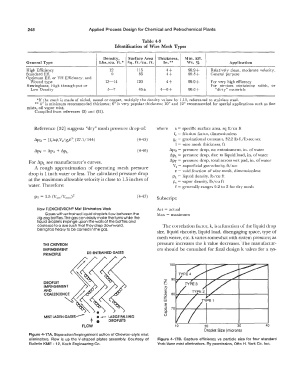
                 How FLEXICHEVRON®  Mist Eliminators Work          Act =  actual
                    Gases with entrained liquid droplets flow between the   Max  =  maximum
                 zig-zag baffles. The gos can easily make the turns while the
                 liquid droplets impinge upon the walls of the baffles and
                 coalesce to a size such that they drop downward,    The correlation factor,  k, is a function of  the liquid drop
                 being too heavy to be carried in the gas.
                                                                   size, liquid viscosity,  liquid load,  disengaging space,  type of
                                                                   mesh weave, etc. k varies somewhat with system pressure; as
                   THE CHEVRON                                     pressure increases  the k value decreases. The manufactur-
                   IMPINGEMENT                                     ers  should be  consulted for final  design  k valves  for a  sys-
                   PRINCIPLE          DE-ENTRAINED GASES


                    MIST LADEN GASES--   .i  e -  LARGE FALLING
                                       T  e    DROPLETS
                                   FLOW                                   10           20            30         40
                                                                                       Droplet Size (microns)
             Figure 4-17A. Separation/Impingement action of Chevron-style mist
             eliminators.  Flow is up the V-shaped  plates assembly.  Courtesy  of   Figure  4-178.  Capture  efficiency vs  particle  size  for four standard
             Bulletin  KME - 12,  Koch Engineering Co.             York-Vane mist eliminators.  By permission, Otto H. York Co.  Inc.

