


Page 351 - APPLIED PROCESS DESIGN FOR CHEMICAL AND PETROCHEMICAL PLANTS, Volume 1, 3rd Edition
P. 351
Mixing of Liquids                                       319

              Five forces that can usually be used for scale-up are:   Heat  Transfer,  Hydraulic Similarity  [29]:
              •  Input force from mixer,  function of [25]
                 impeller speed                                     h  =  f (N, D, p, µ,  cp, k, d)           (5-60)
                 impeller diameter
              •  Opposing forces,  functions of
                 viscosity                                          (      result          appiied force
                 density of fluid                                    system conductivity  J  (        J       (5-61)
                                                                                      = f  resisting force
                 surface tension
              •  Dynamic  similarity  requires  that  the  ratio  of input
                force, viscosity,  density,  and surface tension be  equal.   (hi)= (N�2pJ [c�µJ  (�J
                For the same fluid,  only two of these four forces need                                        (5-62)
                be equal, because the density and viscosity will be the
                same  [34,  29].                                  x, y,  z  are empirical exponents
                  The  geometric  and  dynamic  similarity  can  use   k =  thermal conductivity
                dimensionless groupings.                          d =  heal transfer tube diameter
              •  Geometric  [29]:                                 p  = density of fluid  or specific gravity
                                                                  µ = viscosity of fluid
                                                         (5-55)
                                                                    Blending,  Hydraulic  Similarity:
                Xm,  XP  = dimension of model.  and scale-up unit,
                        respectively                                8  =  f (N,  D, p, µ,  T)                 (5- 63)
                   XR  =  ratio of dimensions
              •  Dynamic  [29]:                                   where  8  =  time
                                                                       T  =  tank diameter


                                                                    (Result/system  conductivity)  =  f  (applied  force/resis-
                                                                  tancy force)
            F  =  force
              Subscripts:  l  = inertia force                       8Np  ([ND2p/µ])'  (D/T)Z                  (5- 64)
                        v  = viscosity force
                        G  =  gravity                             x and z  are empirical coefficients.
                        C'  =  interfacial tension
                        R  =  ratio                               Example 5-1: Scale-up from Small Test Unit  [32], See
                        m  =  model                               Figure 5-34
                        p  =  :=irototype
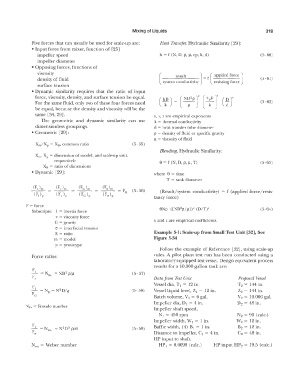
                                                                    Follow  the  example  of Reference  [32], using scale-up
              Force ratios:                                       rules.  A pilot plant test run has  been  conducted  using a
                                                                  laboratory equipped test vessel.  Design equivalent process
                                                                  results for a  10,000 gallon tank are:
               F1
              F   =  N  Re  = ND 2  p/µ                  (5- 57)
                v                                                 Data from  Test Unit               Proposal Vessel
                                                                  Vessel dia,  T1  =  12 in.         T2  =  144 in.
                                                        (5- 58)   Vessel liquid level,  Z 1  =  12 in.   Z 2  =  144 in.
                                                                  Batch volume, V 1  =  6 gal.       V 2  =  10,000 gal.
                                                                  Impeller dia,  0 1  =  4  in.      D2  =  48  in.
            "Fr  =  Froude number
                                                                  Impeller shaft speed,
                                                                    N 1  =  450 rpm                  N2  =  90  (calc.)
                                                                  Impeller width, ,,v =  I  in.     v\/2  =  12 in.
                                                                                 1
                                                        (5- 59)   Baffle width,  (4)  B 1  =  1  in.   B2  =  12 in.
                                                                  Distance to  impeller,  C 1  =  4 in.   C 2  =  48 in.
                                                                  HP input to shaft,
              Nwe  = ,veber number                                  HP1  =  0.0098  (calc.)   HP input HP 2  =  19.5  (calc.)

