


Page 347 - APPLIED PROCESS DESIGN FOR CHEMICAL AND PETROCHEMICAL PLANTS, Volume 1, 3rd Edition
P. 347
Mixing of Liquids                                       315

           3 and 5-4 present the relationships  of the major variables   the two variables can be established. The third variable is
           for the two most important cases of mixing.           tied  through  the  power curves  (plot of power number v.
                                                                 NRe•  see  Figures  5-13,  5-14,  and  5-15). Figure  5-28  shows
              Often, exact or true kinematic  and  dynamic similarity   that geometric and dynamic similarity  can develop useful
           cannot be achieved in a  system requiring small  scale  test-   relationships for some situations [29], but not all, and it is
           ing to determine the effect of the design,  or flexibility in   not  truly  possible  to  prepare  one  dimensionless  group
           design to allow for final design "trimming." Consideration   expressing a  process relationship.  This suggests  that care
           should definitely be given to such flexibility as  (a)  mixing   must be used in resorting only  to a dimensionless number
           impeller designs  that can  be  modified without excessive   for process correlations.  Also see Figures 5-29 and 5-30.
           cost,  or the need to build a completely new/larger/small-   Because the most common impeller type is the turbine,
           er unit,  (b)  multiple  gear  ratios  for the  gear drive,  with   most scale-up published studies have been devoted to that
           spare  ratio gears  to adjust speeds,  and  (c)  either variable   unit.  Almost all  scale-up  situations  require duplication of
           speed driver or oversized driver to  allow  for horsepower   process  results  from  the  initial  scale  to  the  second  scaled
           adjustments.                                          unit.  Therefore,  this is  the  objective  of the outline  to fol-
             The dynamic response used to describe fluid motion in   low,  from Reference  [32]. The  dynamic  response  is  used
           the system is bulk velocity.  Kinematic similarity  exists with   as  a reference for agitation/mixer behavior for a defined
           geometric similarity in turbulent agitation  [32]. To  dupli-   set  of process  results.  For  turbulent  mixing,  kinematic
           cate  a  velocity  in  the  kinernatically  similar  system,  the   similarity occurs with geometric similarity,  meaning fixed
           known  velocity  must be  held  constant,  for example,  the   ratios exist between corresponding velocities.
           velocity of the tip speed of the impeller must be constant.   For scale-up procedure,  refer to Figure  5-31, which out-
           Ultimately,  the process  result should be duplicated in the   lines the steps involved in selecting commercial or industri-
           scaled-up design. Therefore,  the geometric similarity goes   al mechanical agitation equipment  when based on test data.
           a  long way  in  achieving  this  for some  processes,  and the
           achievement of dynamic  and/or  kinematic  similarity  is   • Test data should be planned by knowledgeable special-
           sometimes not that essential.                             ists in order to obtain the range, accuracy, and scope of
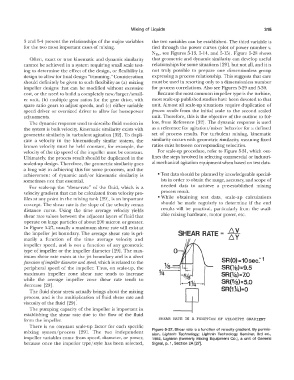
             For  scale-up  the  "shear-rate"  of the  fluid,  which  is  a   needed  data  to  achieve  a  pre-established  mixing
           velocity gradient that.  can be calculated from velocity pro-   process result.
           files at any point in the mixing tank [29], is an important   • While  obtaining  test  data,  scale-up  calculations
           concept.  The shear rate is the slope of the velocity versus   should  be  made  regularly  to  determine  if the  end
           distance  curve.  Using  the  time  average  velocity  yields   results  will  be  practical,  particuiarly  from  the  avail-
           shear rate vaiues between the adjacent layers  of fluid that   able mixing hardware,  motor power,  etc.
           operate on large particles of about 200 micron or greater.
           In  Figure 5-27,  usually a maximum shear rate will exist at
           the  impeller jet boundary.  The  average  shear rate  is  pri-   SHEAR  RATE =  b.. V
                                                                                                 b..Y
           marily  a  function  of  the  time  average  velocity  and
           impeller speed,  and  is  not a  function  of any  geometric
           type of impeller or the impeller diameter [29]. The max-
           imum shear rate exists at the jet boundary and is a  direct
           function of  impeller diameter and speed,  which is related to the                 SR (0) = 10 sec:  1
           peripheral  speed  of the  impeller.  Thus,  on  scale-up,  the                    SR(Va)=9.5
           maximum  impeller  zone  shear  rate  tends  to  increase                          SR(1/4)=  7.0
           while  the  average  impeller  zone  shear  rate  tends  to                        SR(S/a)=S.O
           decrease  [29].
             The fluid shear stress actually brings  about the mixing                         SR(1°Ui)=O
           process,  and is  the  multipiication  of fluid shear rate  and
           viscosity of the fluid  [29].
             The pumping capacity of the impeller is  important in
           establishing  the  shear  rate  due  to  the  flow  of the  fluid
           from the impeller.                                       SHEAR RATE IS A FUNCTION OF VELOCITY GRADI�NT
             There  is  no  constant scale-up  factor for each  specific
           mixing  system/process  [29J.  The  two  independent   Figure 5-27. Shear rate is a function of velocity gradient.  By permis-
                                                                 sion,  Lightnin  Technology;  Lightnin  Technology  Seminar,  3rd  ed.,
           impeller variables come from  speed, diameter,  or power,   1982,  Lightnin  (formerly  Mixing  Equipment Co.),  a  unit  of  General
           because  once  the  impeller type/style  has  been  selected,   Signal, p.  1, Section  2A [27].

