


Page 355 - APPLIED PROCESS DESIGN FOR CHEMICAL AND PETROCHEMICAL PLANTS, Volume 1, 3rd Edition
P. 355
Mixing of Liquids                                       323

           be  certain  that  the  proper  fluid  mixture  ts  sampled  or   etc., will be the same  in the  larger system.  Once it can be
           removed.                                              determined  whether  the  process  result  is  controlled,
              Side  entering  mixers  (usually  propellers)  as  shown  in   more  or less,  by  flow  or turbulence,  the  scale-up  can  be
           Figure  5-23G  are  placed  18-24  inches  above  a  flat tank   more  intelligently  analyzed with  the  use  of the  relations
           floor with  the  shaft  horizontal,  and  at  a  10°  horizontal   previously  presented;  noting  that head,  H,  is  the  turbu-
           angle  with  a vertical  plane  through  the  tank  centerline.   lence indicator.  Generally speaking, for fixed power input
           This  equipment is  used  for  fluids  up  to  500  centipoise   the relative proportions of flow and turbulence in a given
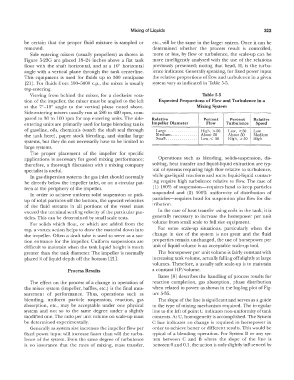
           [21).  For fluids from 500-5000  c.p.,  the  mixer  is  usually   system vary as indicated in Table 5-5.
           top entering.
              Viewing  from  behind  the  mixer,  for a  clockwise  rota-             Table 5-5
           tion of the impeller,  the mixer must be  angled to  the left   Expected Proportions of Flow and Turbulence in a
           at  the  7°-10°  angle  to  the  vertical  plane  noted  above.          Mixing System
           Side-entering mixers usually  run at 280  to 420 rpm, com-
           pared to  30  to  100  rpm for top entering units.  The  side-   Relative   Percent    Percent   Relative
           entering units are primarily used for large blending tanks   Impeller Diameter   Flow   Turbulence   Speed
           of gasoline,  oils,  chemicals  (watch  the shaft seal  through   Large ............. ...  High,  > 50   Low,  <50   Low
                                                                   Medium ..............  About 50
           the  tank  here), paper  stock  blending,  and  similar  large   Small. .. .......... ...  Low,< ,50   About 50   Medium
           systems,  but they do not necessarily  have  to be limited  to                        High,  > 50   High
           large  systems.
              The  proper  placement  of  the  impeller  for  specific
           applications  is  necessary  for good  mixing  performance;   Operations  such  as  blending,  solids-suspension,  dis-
           therefore,  a thorough  discussion with a  mixing company   solving,  heat transfer and liquid-liquid extraction are  typ-
           specialist is useful.                                 ical  of systems requiring high flow relative  to  turbulence,
              In gas dispersion systems the gas inlet should normally   while gas-liquid reactions and some liquid-liquid contact-
           be  directly  below  the  impeller inlet,  or on  a circular pat-   ing require  high  turbulence  relative  to  flow.  The  case  of
           tern at the periphery of the impeller.                (1)  100%  of suspension-requires head  to keep particles
              In  order to  achieve uniform solid  suspension  or pick-   suspended  and  (2)  100%  uniformity  of distribution  of
           up of solid particles off the bottom,  the upward velocities   particles-requires  head for suspension plus flow  for dis-
           of  the  fluid  streams  in  all  portions  of  the  vessel  must   tribution.
           exceed the terminal  settling velocity of the particular par-   In the case of heat transfer using coils in the tank,  it is
           ticles.  This can be determined by small scale tests.   generally  necessary  to  increase  the  horsepower per unit
              For  solids  which  float,  or which  are  added  from  the   volume from small scale to full  size equipment.
           top,  a vortex action  helps  t.o  draw the material  down into   For  some  scale-up  situations,  particularly  when  the
           the impeller.  Often  a draft  tube is used  to  serve  as  a sue-   change  in  size  of the  system  is  not great  and  the  fluid
           t.ion  entrance  for the  impeller.  Uniform  suspensions  are   properties remain unchanged,  the use of horsepower per
           difficult to maintain when the tank liquid height is much   unit of liquid volume is an acceptable scale-up tool.
           greater than the  tank diameter.  The impeller is  normally   The horsepower per unit volume is fairly constant with
           placed )i of liquid depth  off the bottom  [21).      increasing tank volume, actually falling off slightly at large
                                                                 volumes.  Therefore,  a  usually  safe  scale-up is  to maintain
                              Process Results                    a constant HP /volume.
                                                                   Bates  [8]  describes  the  handling of process  results for
              The effect on  the process  of a  change  in  operation  of   reaction  completion,  gas  absorption,  phase  distribution
           the mixer system  (impeller,  baffles,  etc.)  is  the final  mea-   when related to power,  as shown in the log-log plot of  Fig-
           surement  of  performance.  Thus,  operations  such  as   ure 5-35.
           biending,  uniform  particle  suspension,  reaction,  gas   The slope of the line is significant and serves as a guide
           absorption,  etc.,  may  be  acceptable  under  one  physical   to  the  type of mixing mechanism  required.  The irregular
           system  and  not  so  to  the  same  degree  under  a  slightly   line to the left of  point U indicates non-uniformity of tank
           modified one. The ratio per unit volume on scale-up must   contents. At U, homogeneity is accomplished.  The System
           be determined experimentally.                         C  line  indicates  no  change  is  required  in  horsepower in
              Generally as system size increases the impeller flow per   order to achieve better or different results. This would be
           fixed  power input will increase faster than will the  turbu-   typical  of a  blending operation.  For System  B  or any sys-
           lence of the system.  Even the same  degree of turbulence   tem  between  C  and  B  where  the  slope  of  the  line  is
           is  no  insurance  that the  rates  of mixing,  mass  transfer,   between O and 0.1, the act.ion is only slightly influenced by

