


Page 352 - APPLIED PROCESS DESIGN FOR CHEMICAL AND PETROCHEMICAL PLANTS, Volume 1, 3rd Edition
P. 352
320                       Applied  Process Design for Chemical  and Petrochemical  Plants


                                                                                                               cl
                                                                                                             bw


              z


                                                           cl                                             Cone tie-in
                                                                     For very low                           to shell
                                                                     impellers,  add
                                                                     1 /2 width  baffles
                                                                     in cone,  off wall


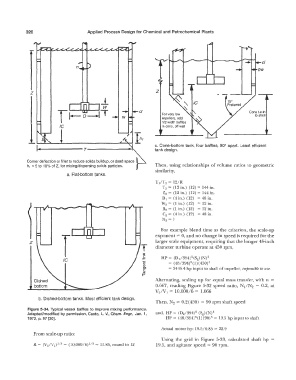
                                                                  c.  Cone-bottom tank,  four baffles,  90° apart.  Least efficient
                                                                  tank design.

            Corner deflection or fillet to reduce solids buildup,  or dead space
            h 1  = 5 to  10% of Z,  for mixing/dispersing solids particles.   Then,  using relationships  of volume  ratios  to  geometric
                                                                  similarity,
                             a.  Flat-bottom tanks.
                                                                  T1/T 2  =  12/R
                                                                     T 2  =  (12 in.)  (12) =  144 in.
                                                                     Z2  =  (12 in.)  (12) =  144 in.
                                                                     D1  =  (4 in.)  (12)  =  48 in.
                                                                     W 2  =  (1  in.)  (12)  =  12 in.
                                                                     B2  =  (1  in.)  (12)  =  12 in.
                                                                     C2  =  (4 in.)  (12)  =  48 in.
                                                                     N2  =?

                                                                     For example  blend time as  the  criterion,  the  scale-up
                                                                  exponent= 0, and no change in speed is required for the
             z                                                    larger scale equipment,  requiring that the longer 48-inch
                                                                  diameter turbine operate at 450 rpm,
                                                             Cl)
                                                             §       HP =  (DT/394)5(Scr) (N)3
                                                             c          =  (48/391) 5 (1)°(450)3
                                                             Cl)
                                                             Ol         = 2445.4 hp input to shaft of impeller,  impossible to use.
                                                             c
                                                             �
               Dished                                             Alternating,  scaling up for equal mass  transfer,  with  n  =
               bottom                                             0.667,  reading Figure  5-32  speed  ratio,  N1/N2  =  0.2,  at
                                                                  V2/V 1  =  10,000/6 =  1,666
                 b.  Dished-bottom tanks.  Most efficient tank design.
                                                                  Then, N2  =  0.2(450)  =  90 rpm shaft  speed
             Figure  5-34.  Typical  vessel  baffles to  improve  mixing  performance.
             Adapted/modified  by  permission,  Casto,  L.  V.,  Chem.  Engr.,  Jan.  1,   and,  HP= (0 2 /394)5  (Sg)  (N)3
                                                                                   5
                                                                                         3
             1972,  p. 97 [30].                                        HP= (48/391) (1)(90) =  19.5 hp input to shaft
                                                                     Acural motor hp:  19.5/0.85  ==  22.9
               From scale-up ratio:
                                                                     Using  the  grid  in  Figure  5-33,  calculated  shaft  hp
                     2
               R =  (V /V 1)113  =  (10,000/6) 113  =  11.85, round to  12   19.5, and agitator speed  =  90 rpm.

