


Page 360 - APPLIED PROCESS DESIGN FOR CHEMICAL AND PETROCHEMICAL PLANTS, Volume 1, 3rd Edition
P. 360
328                      Applied Process Design for Chemical and Petrochemical  Plants

                    barrier such as tube or flat plate/wall  of vessel,   fies features of the system  (vessel,  impeller,  fluid  proper-
                    hr (sq ft)  (°F)  Btu                      ties)  that influence the resulting heat transfer coefficient.
                r;  =  fouling resistance (factor)  associated with fluid   The generalized representation  is:
                    on inside  (heat transfer fluid)  of heat transfer
                    barrier such as tube or flat plate/wall of vessel,
                    hr (sq ft)  (°F)  Btu                                                         (  �    )0.1
                                                                             =  0.17 (  NRc  }0.67  ( NPR  )0.37
              A,.vg  =  average of inside and outside tube surface area,
                    sq ft/ft                                                  (�rs(:. r                    (5-71)


                                                      (5- 70)
                                                               N  Nu  =  Nusselt number
                                                                                      (  D 2 µNp  J-=   10.754Df N"' \
                                                               N  Re  =  Reynolds number  =
         rw  =  resistance of tube wall,  L,vlkw;  hr (sq ft) (°F) /Btu                               µ
                                                                                     (  c � µ)
         L; =  thickness of tube wall, ft                      NPR  =  Prandtl number  =

            For estimating or even practical purposes, some of the
         components of the equation can be simplified. The ratio,                                           (5-72)
         A;/  A,,, can be used as  (D;ID 0).  Note that consistent units
         must be used for kw  and 1..,,,.
           In  mixing,  the  moving  liquid  in  a vessel  establishes  a   where  D  =  impeller diameter,  ft
         heat transfer film  coefficient on  the  surface  of the  heat   N  =  impeller speed, rpm
         transfer barrier such  as  tube  coils,  or  the  internal  vessel   p  =  density,  lb/cu ft
         shell wall with  a jacket exterior to this wall for circulating   µ  =  bulk viscosity of fluid
         heating and cooling fluid.  This  film  becomes a  function   �  =  wall viscosity at film process fluid temperature at
                                                                         heat transfer surface
         of the movement of the fluid against and/  or next to  the   m  =  experimentally  determined exponent,  depending
         heat transfer barrier surface.  Thus,  the  thinner the film,   on bulk viscosity
         the  better  the  heat  transfer.  Therefore,  the  selection  of   n0  =  mean mixer side film coefficient of tank temperature
         the  type  of impeller,  its  rotational  speed,  and  the  fluid   k  =  thermal conductivity of fluid,  Btu/hr  /sq ft/°F  /ft
         properties  all  influence  the actual  flow  of heat  through   d  = d,  =  tube OD, ft
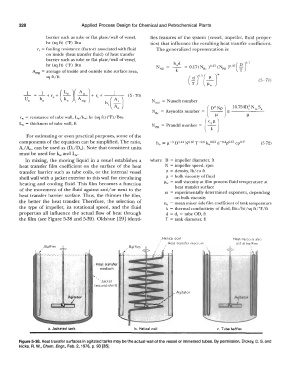
         the film  (see Figure  5-38 and 5-39). Oldshue  (29)  identi-   T  =  tank diameter,  ft


                                                                   r  Helical  con               Heat,nq  co.ls also
                                                                     I  Heat-transfer medium      act as  baffles
                   / Baffles
                -  /   _....._ __  -·- ---- � - - - �   .Baffles
                                                                     I
                          II
                J
                                    -
                                       - Heat-transfer
                                          medium
                                          • Jacket
                                        (second shell)
                                                                        ,,  Agitator
                             Agitator
                               I
                              I
                ....
                ........

                     a.  Jacketed tank                  b.  Helical coil                  c.  Tube baffles

         Figure 5-38. Heat transfer sur1aces in agitated tanks may be the actual wall of the vessel or immersed tubes.  By permission,  Dickey,  D. S. and
         Hicks,  R. W., Chem.  Engr.,  Feb.  2,  1976,  p. 93 [35].

