


Page 417 - APPLIED PROCESS DESIGN FOR CHEMICAL AND PETROCHEMICAL PLANTS, Volume 1, 3rd Edition
P. 417
Ejectors and Mechanical Vacuum Systems                            385


                  8,000
              :E                                         I
              :::,              CONDENSATION  BONUS
              :::,         -

              �                 904-R2  at 240  rpm                                      70of    SEAL
              ;::i
              �   7,000                                 I     OF sA.i. ""poR
              <(                                          20
                                                         1                 VAPOR         70°F SEAL
              �                                           1100F  SAT.
              LL.                                                                         60oFSEA
              0                                             aooF SAT.  VAPOR                            �
              >  ..                                                                                  ---
              1-  6,000                                                                                   -........_


              �            -                                    60°F DRY AIR             60oF     SEAL
              0:
              <)

                                I     I     I     I            I     I     I     I           I     I     I
                                                       15                            20                      24
                                             VACUUM,  INCHES OF MERCURY

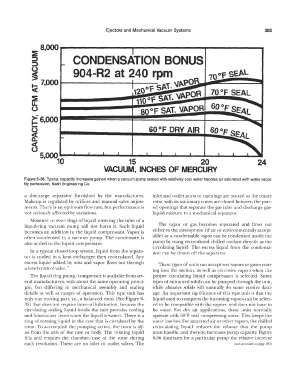
           Figure 6-36. Typical capacity increases gained when a vacuum pump sealed with relatively cool water handles air saturated with water vapor.
           By permission,  Nash  Engineering Co.

           a  discharge  separator  furnished  by  the  manufacturer.   inlet and outlet ports or openings are ported so the rotary
           Makeup is  regulated by  orifices  and manual  valve  adjust-   rotor with its stationary cones are closed between the port-
           ments. There is an optimum flow rate, but performance is   ed openings that separate the gas inlet and discharge gas-
           not seriously affected by variations.                 liquid mixture to a mechanical separator.
              Moisture or even slugs of liquid entering  the inlet of a
           liquid-ring  vacuum  pump  will  not  harm  it.  Such  liquid   The  vapor  or  gas  becomes  separated  and  flows  out
           becomes an addition  to  the liquid cornpressanl.  Vapor is   either to the atmosphere  (if  air or environmentally accept-
           often  condensed  in a  vacuum  pump.  The  condensate  is   able)  or a condensable vapor can be condensed inside the
           also added to  the liquid cornpressant.               pump by using recirculated chilled coolant directly as the
                                                                 circulating  liquid.  The  excess  liquid  from  the  condensa-
              In a  typical  closed-loop system, liquid from the separa-   tion can be drawn off the separator.
           tor is  cooled in a  heat exchanger then  recirculated.  Any
           excess  liquid.  added by mist and vapor flows out through   These types of  units can accept wet vapors or gases com-
           a  level-control valve."
                                                                 ing into  the suction,  as well  as  corrosive  vapors when  the
              The liquid ring pump/compressor is available from sev-   proper  circulating  liquid  compressan t  is  selected.  Some
           eral  manufacturers,  with about the same operating princi-   types of entrained solids can be pumped through the unit,
           ple,  but  differing  in  mechanical  assembly  and  sealing   while  abrasive  solids will  naturally  do  some  erosive  dam-
           details  as  well  as  ranges  of operation.  This  type  unit has   age.  An important significance of this type unit is that the
           only one moving part,  i.e., a balanced rotor (See Figure 6-   liquid used to compress the incoming vapors can be select-
           35)  that does not require internal lubrication, because the   ed to be compatible with the vapors,  and does not have to
           circulating sealing liquid inside the  unit provides cooling   be  water.  For  dry  air  applications,  these  units  normally
           and lubrication  (even when the liquid is water). There is a   operate with  60°F seal  compressing water.  This keeps  the
           ring of rotating liquid in  the case that is circulated by  the   waler loss low.  For saturated air or other vapors,  the chilled
           rotor.  To  accomplish  the pumping action,  the rotor is  off   recirculating  liquid  reduces  the  volume  that  the  pump
           set  from  the  axis  of the  case  or body.  The  rotating  liquid   must handle, and thereby,  increases pump capacity.  Figure
           fills  and  empties  the  chamber/case  of the  rotor  during   6-36 illustrates for a particular pump  the  relative increase
           each  revolution.  There  are  no  inlet or outlet valves.  The                         (text continued Dtl page 393)

