


Page 414 - APPLIED PROCESS DESIGN FOR CHEMICAL AND PETROCHEMICAL PLANTS, Volume 1, 3rd Edition
P. 414
382                       Applied Process Design for Chemical and Petrochemical  Plants

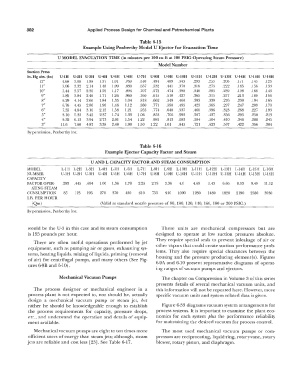
                                                            Table 6-15
                                    Example Using Penberthy Model U Ejector for Evacuation Time
                         U MODEL EVACUATION TIME  (in minutes per 100 cu ft at 100 PSIG Operating Steam Pressure)
                                                                    Model Number
            Suction Press
            In. Hg abs.  (hs)   U-lH  U-2H  U-3H  U-4H  U-5H  U-6H  U-7H  U-8H  U-9H  U-lOH  U-llH  U-12H  U-13H  U-14H  U-15H  U-16H
                  12"      4.68   3.08   1.98   1.37   1.01   .769   .610   .494   .409   .343   .293   .253   .206   .171   .145   .123
                  11"      5.06   3.32   2.14   1.48   1.09   .830   .657   .532   .441   .370   .316   .273   .222   .185   .156   .133
                  10"      5.44   3.57   2.30   1.59   1.17   .894   .707   .572   .474   .398   .340   .293   .239   .198   .168   .143
                  9"       5.85   3.84   2.46   1.71   1.26   .960   .760   .615   .510   .427   .365   .315   .257   .213   .180   .151
                   8"      6.29   4.14   2.66   1.84   1.35   1.04   .818   .662   .549   .460   .393   .339   .276   .230   .194   .165
                   7"      6.76   4.45   2.86   1.98   1.46   1.12   .880   .771   .590   .495   .423   .365   .297   .247   .209   .178
                   6"      7.35   4.84   3.10   2.15   1.58   1.21   .955   .774   .640   .537   .460   .396   .323   .268   .227   .193
                   5"      8.10   5.33   3.42   2.37   l.74   1.33   1.06   .853   .706   .592   .507   .437   .356   .295   .250   .213
                   4"      9.32   6.13   3.94   2.73   2.01   1.54   1.22   .981   .813   .683   .584   .504   .410   .340   .288   .245
                   3"      11.6   7.60   4.87   3.38   2.48   1.90   1.50   1.22   1.01   .845   .721   .623   .507   .422   .356   .304
             By permission, Penberthy Inc.


                                                            Table 6-16
                                             Example Ejector Capacity Factor and Steam

                                       U AND L CAPACITY FACTOR AND STEAM CONSUMPTION
            MODEL          L-11-1   L-2H  L-3H   L-4H  Ir51-I   L-61-1   L-71-1   L-81-1   L-9I-I   L-lOH   L-llH  L-12H  L-131-1   Irl4H  L-151-1  L-161-1
            NUMBER         U-1!-1  U-21-1  U-3I-l   U-4I-I  U-5H  U-6H  U-7H  U-8H  U-9H  U-lOH  U-1 lI-I   U-121-1  U-13H  U-14H  U-15H  U-16I-I
            CAPACITY
            FACTOR OPER-   .293   .445   .694   1.00   1.36   1.78   2.25   2.78   3.36   4.0   4.69   5.4.3   6.66   8.03   9.49   11.12
              ATING STEAM
            CONSUMPTION     85   125   195   270   370   ·180   610   755   910   1090   1280   1480   1820   2190   2580   3030
            LB.  PER HOUR
              (Qm)                         (Valid at standard nozzle pressure of 80,  100,  120,  140,  160,  180 or 200 PSlG.)
            By permission, Penberthy Inc.


             would be the U-3  in this  case and its steam  consumption   These  units  are  mechanical  compressors  but  are
             is  195  pounds per hour.                             designed  to  operate  at  low  suction  pressures  absolute.
                                                                   They  require  special  seals  to  prevent inleakage  of air or
               There  are  often  useful  operations  performed  by jet
             equipment,  such as  pumping air or gases,  exhausting sys-   other vapors  that could create suction performance prob-
             tems,  heating liquids, mixing of  liquids, priming (removal   lems.  They  also  require  special  clearances  between  the
             of air)  for centrifugal  pumps,  and many  others  (See Fig-   housing  and  the  pressure  producing  elemenr(s).  Figures
             ures 6-9B and 6-10).                                  6-9A  and  6-10 present representative diagrams  of operat-
                                                                   ing ranges of vacuum pumps and ejectors.
                          Mechanical Vacuum Pumps                    The chapter on Compression in Volume 3 of this series
                                                                   presents  details  of several  mechanical  vacuum  units,  and
               The  process  designer  or  mechanical  engineer  in  a   this information will not be repeated here. However,  more
             process  plant is  not expected  to,  nor should  he,  actually   specific vacuum units  and system related data is given.
             design  a  mechanical  vacuum  pump  or  steam  jet,  but
             rather  he  should be  knowledgeable  enough  to  establish   Figure 6-33 diagrams vacuum system arrangements for
             the  process  requirements  for  capacity,  pressure  drops,   process systems.  It is important to examine the plant eco-
             etc.,  and  understand  the  operation  and details of equip-   nomics  for each  system  plus  the  performance  reliability
             ment available.                                       for maintaining the desired vacuum for process control.
               Mechanical vacuum pumps are eight to ten times more   The  most  used  mechanical  vacuum  pumps  or  com-
             efficient users of energy  than steam jets;  although,  steam   pressors are reciprocating,  liquid-ring,  rotary-vane, rotary
            jets are reliable and cost less  [23]. See Table 6-17.   blower,  rotary piston, and diaphragm.

