


Page 455 - APPLIED PROCESS DESIGN FOR CHEMICAL AND PETROCHEMICAL PLANTS, Volume 1, 3rd Edition
P. 455
Process Safety and Pressure-Relieving Devices                        421


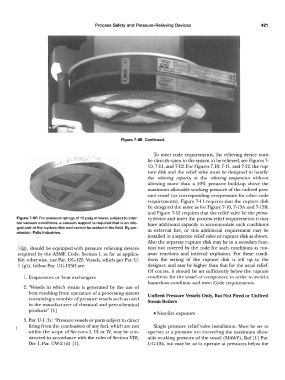
                                                   Figure 7-9E.  Continued.

                                                                To  meet code  requirements,  the  relieving device  must
                                                              be directly open to the system to be relieved, see Figures 7-
                                                              10, 7-11, and 7-12. For Figures 7,10, 7-11, and 7-12, the rup-
                                                              ture disk and the relief valve must be designed  to handle
                                                              the  relieving  capacity  at  the  relieving  temperature  without
                                                              allowing  more  than  a  10%  pressure  build-up  above  the
                                                              maximum allowable working pressure of the unfired pres-
                                                              sure vessel  ( or corresponding overpressure for other code
                                                              requirements). Figure  7-11  requires  that the rupture  disk
                                                              be designed the same as for Figure 7-10,  7-13A and 7-13B;
                                                              and Figure 7-12 requires that the relief valve be the prima-
        Figure 7-9F.  For pressure ratings of 15 psig or lower,  subject to inter-   ry device and meet the process relief requirements;  it may
        nal vacuum conditions, a vacuum support is required that is an inte-   have additional capacity to accommodate such conditions
        gral part of the rupture disk and cannot be added in the field. By per-   as  external  fire,  or  this  additional  requirement may  be
        mission, Falls Industries.
                                                              installed in a separate relief valve or rupture disk as shown.
                                                              Also  the separate rupture disk may be in a secondary func-
         1 ('g), should be equipped with  pressure relieving devices   tion  not covered  by  the code for such  conditions as  run-
        required  by  the ASME Code,  Section  I,  as far as  applica-   away  reactions  and  internal  explosion.  For  these  condi-
        ble; otherwise, use Par.  UG-125. Vessels, which per Par.  U-   tions  the  setting  of  the  rupture  disk  is  left  up  to  the
         1  (g)), follow  Par.  UG-125ffare:                  designer,  and may be higher than that for the usual relief.
                                                              Of course,  it should  be set sufficiently  below  the rupture
           1. Evaporators or heat exchangers                  condition for the vessel or component in order to avoid a
                                                              hazardous condition and meet Code requirements.
           2.  ''Vessels  in  which  steam  is  generated  by  the  use  of
             heat resulting from operation of a processing system   Unfired Pressure Vessels Only,  But Not Fired or Unfired
             containing a number of  pressure vessels such as used   Steam Boilers
             in the manufacturer of chemical and petrochemical
             products"  [l]
                                                                • Non-fire exposure
           3.  Par.  U-1  (h)  "Pressure vessels or parts subject to direct
             firing from the combustion of any fuel, which are not   Single pressure  relief valve installation.  Must be set to
             within  the scope  of Sections I,  III  or IV,  may  be  con-   operate at a pressure not exceeding the maximum allow-
             structed in accordance with the rules of Section VIII,   able working pressure of the vessel  (MAWP), Ref [ l]  Par.
             Div.  I,  Par.  UW-2  (d)  [l].                  UG-134,  but may  be set to operate at pressures below the

