


Page 510 - APPLIED PROCESS DESIGN FOR CHEMICAL AND PETROCHEMICAL PLANTS, Volume 1, 3rd Edition
P. 510
476                       Applied  Process Design for Chemical and  Petrochemical  Plants

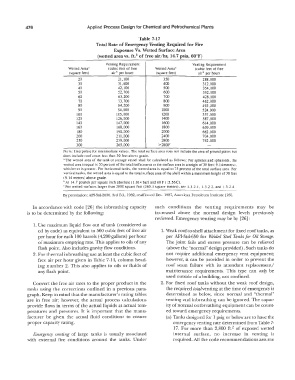
                                                           Table 7-17
                                         Total Rate of  Emergency Venting Required for Fire
                                                 Exposure Vs. Wetted Surface Area
                                                          3
                                          (wetted area vs. ft. of free air/hr,  14.7 psia,  60°F)
                                             Venting  Requirement                 Venting  Requirement
                              Welted Area"    ( cubic  feet of free   Welted Area"   (cubic  feet of free
                              (square  feet)    air "  per hour)   (square  feet)   air" per  hour)
                                  20               21.100             350             288.000
                                  30               31,600             400             312,000
                                  40               42,100             500             354,000
                                  50               52. 700            600             392,000
                                  60               63.200             700             428,000
                                  70               73,  700           800             462,000
                                  80               84.200             900             493,000
                                  90               94,800            1000             524.000
                                 100              105,000            1200             557 ,000
                                 120              126,000            1400             587,000
                                 140              147,000            1600             614,000
                                 160              168.000            1800             639,000
                                 180              190,000            2000             662.000
                                 200              211,000            2400             704,000
                                 250              239.000            2800             742,000
                                 300              265,000           >2800"
                            NoTE:  Interpolate for intermediate values. The total surface area does not include the area of ground plates  but
                            does  include roof areas  less than  30 feet above grade.
                            "The  welted area of the  tank  or storage  vessel  shall be  calculated as follows:  For spheres and spheroids.  the
                            wetted area is equal  to 55 percent of the total surface area or the surface area to a height of 30 feet 19. 14 meters).
                            whichever is greater.  For horizontal  tanks, the  welted area is equal to 75 percent of the total surface area.  For
                            vertical tanks, the welted area is equal to the total surface area of the shell within a maximum  height of 30 feet
                            19.14 meters)  above  grade.
                            h At  14. 7  pounds per square  inch absolute  (  1.014 bar)  and 60 F  (  15. 56 C).
                            "For welted surfaces  larger than  2800 square  feet (260. J  square  meters), see  1.3.2.1.  1.3.2.2. and  1.3.2.4.

                            By permission:  API-Std-2000,  3rd Ed.,  1982,  reaffirmed Dec.  1987, American Petroleum Institute  [26].

               In accordance with code  [26]  the inbreathing capacity   such  conditions  the  venting  requirements  may  be
            is to be determined by the following:                 increased  above  the  normal  design  levels  previously
                                                                  reviewed.  Emergency venting may be by  [26]:
               1. Use  maximum liquid  flow out of tank  (considered as
                 oil by code)  as  equivalent to 560  cubic feet of free air   1. Weak roof-to-shell attachment for fixed roof  tanks, as
                 per hour for each 100 barrels ( 4,200 gallons) per hour   per API-Std-650  for  Weuled Steel  Tanks for Oil Storage.
                 of maximum emptying rate. This applies to oils of  any   The joint fails  and  excess  pressure  can  be  relieved
                 flash point.  Also includes gravity flow conditions.   (above the "normal" design provided). Such tanks do
               2.  For thermal in  breathing use at least the cubic feet of   not require  additional  emergency  vent  equipment;
                 free air per hour given in Table 7-14,  column head-   however,  it can be  provided in  order to  prevent the
                 ing  number 2.  This  also  applies  to  oils  or fluids  of   roof seam  failure  with  its  attendant  replacement/
                 any flash point.                                      maintenance  requirements.  This  type  can  only  be
                                                                       used outside of a building,  not confined.
               Convert the free air rates  to  the proper product in the   2.  For fixed roof tanks  without the weak  roof design,
             tanks  using  the  corrections  outlined  in  a  previous  para-   the required total venting at the time of  emergency is
             graph. Keep in mind that the manufacturer's rating tables   determined  as  below,  since  normal  and  "thermal"
             are  in  free  air;  however,  the  actual  process  calculations   venting and in  breathing can be ignored.  The capac-
             provide  flows  in terms  of the actual  liquids at actual tem-   ity of  normal outbreathing equipment can be count-
             peratures  and  pressures.  It  is  important that  the  manu-   ed toward emergency requirements.
             facturer  be  given  the  actual  fluid  conditions  to  ensure   (a)  Tanks designed for 1  psig or below are to have the
             proper capacity rating.                                      emergency venting rate determined from Table 7-
                                                                          17.  For more  than  2,800  ft. of exposed  wetted
                                                                                                  2
               Emergency  venting  of large  tanks  is  usually  associated   internal  surface,  no  increase  in  venting  is
             with  external  fire  conditions  around  the  tanks.  Under   required. All  the code recommendations assume

