


Page 511 - APPLIED PROCESS DESIGN FOR CHEMICAL AND PETROCHEMICAL PLANTS, Volume 1, 3rd Edition
P. 511
Applied Process Design                                     477

                  that  the  stored  liquid  has  the  physical  and  ther-   Note  that the  above formula is  based  on  the one in API-
                  mal  characteristics of hexane.               RP-520  [10]:

               (b)  Tanks designed for pressures over 1  psig (and up to
                  15  psig maximum as covered by API-Std-2000)  are   Q =  21,000 FA 0·82                    (7-30)
                  to  have  the  emergency  venting  rate  determined
                  from  Table  7-17;  however,  when  the  exposed  sur-   where Q =  total heat input,  BTU/hr
                  face area is above 2,800 ft. 2,  the total rate of  venting
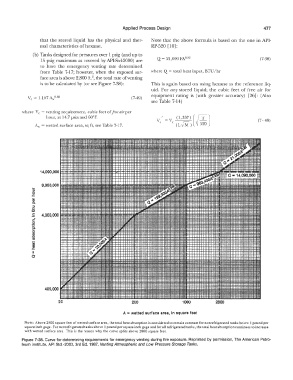
                  is to be calculated by  ( or see Figure 7-38):   This  is again  based on using hexane as  the reference liq-
                                                                uid.  For  any  stored  liquid;  the  cubic  feet of free  air for
                                                                equipment  rating  is  (with  greater accuracy)  [26]:  (Also
             Ve  =  1,107 A" 0·82                       (7-49)
                                                                see Table 7-14)
          where  Ve  = venting requirement,  cubic feet of  free air per
                    hour,  at 14. 7  psia and 60° F,                              (
                                                                  V  = V  (1,337)   rJ;)                     (7- 48)
                A,,.  = wetted surface area,  sq  fl,  see Table 7-17.   c   e  (LfM)  I  520


                  14,090,000
               ..   9,950,000

               :::,
               0
              .c
               i
               :::,
              ai
               c
              .2
              �
              j
               =
              j
               •
              0


                         20                             200                  1000          2800

                                                    A  .. wetted surface area,  In square  feet
           NOTE: Above 2800 square  feet of wetted surface area, the total heat absorption is considered to remain constant for nonrefrigerated tanks below  I  pound per
           square inch gage.  For nonrefrigeratcd tanks above  I  pound per square inch gage and for all refrigerated tanks, the total heat absorption continues to increase
           with wetted surface area.  This  is the reason why the curve splits  above  2800 square  feet.
          Figure 7-38.  Curve for determining requirements for emergency venting during fire exposure.  Reprinted by permission, The American  Petro-
          leum  lnstitute,  API  Std.-2000,  3rd  Ed.  1987,  Venting Atmospheric and Low Pressure Storage Tanks.

