


Page 515 - APPLIED PROCESS DESIGN FOR CHEMICAL AND PETROCHEMICAL PLANTS, Volume 1, 3rd Edition
P. 515
Applied Process Design                                     481

                                                  OPERATING  VENTS

            FILL  IN  THIS  INFORMATION  FOR  NEW  VENT  INSTALLATIONS:
             1.  Type  of Liquid
                Specific  Gravity_          Flash  Point   °F.
             2.  Tank  Capacity  in  Gallons               _                           (11)              (8)
             3.  Tank  is  Above  Ground D  or Below  Ground D                    DIAMETER  OF  VENT  PIPE---+  11-  APPROX.  PRESSURE
                                                                                                    fANk  Will  WITHSTAND
             4.  Tank  is  Vertical O  or  Horizontal  D  Tank  Dia.   ft.
             5.  Rate  of  Filling  (G.P.M.)   Size  Line   _
             6.  Rote  of  tmptying  (G.P.M.)   Size  Line   _
             7.  Approximate  operating  pressure  of  tank   _
             8.  Approximate  pressure  tonk  will  withstand,   _
                                                                 (5)                                         (6)
             9.  Approximate  vacuum  tonk  will  withstand   _   RATE  Of                                RATE  Of
                                                                FILLING                                  EMPTYING
            10.  Is  tank  inerted?           If yes,  approximate   (G.P.M.J                             (G.P.M.J
                blanketing  pressure                      _
                                                                     ��,ml,""""�,i,l\,f;.,,,-m,:?;i,,�,Jm����""'�'"""'����rof
                                                                                                          LINE
            NOTES:
            (Specify any rempercture conditions above or below ambient
            and/  ar special  materials of construction  required)


                                                 EMERGENCY  VENTS
            FILL  IN  THIS  INFORMATION  FOR  NEW  VENT  INSTALLATION:
             l.  Type  of Liquid
                Specific  Gravity_     Flash  Point        °F
                                                                                           r-OPERATING  VENT
                Molecular Weight       Latent  Heat  of
                L\!MValue              Vaporization    BTU/lb.
                                                                                                   (71  APPROX.  PRESSURE  TANK
             2.  Tonk  Capacity  in:  Gallons   or  Barrels.   _                                      Will  WITHSTAND
             3.  Tank  is  Above  Ground  D  or  Below  Ground  D
             4.  Tank  is  Vertical  [].or  Horizontal  O
                                                                                                           (Bl
                Tank  Diameter    Height     or  Length   _                                            APPROX.  VACUUM
                                                                                                      TANK  Wilt  WITHSTAND
             5.  Approximate  operating  pressure  of tank   _
             6.  Valve  setting  on  Operating  vent.-----------
             7.  Approximate  pressure  tank  will  withstand   _
             8.  Approximate  vacuum  tank  wili  withstand   _
             9.  Is  tank  inerted?               lf  yes,  what is
                approximate  blanketing  pressure?        _
            MODIFICATIONS [cheek, where applicable):
                                                   YEs·  No·
            10.  Tank drains  tc  a  remote  area   D  D
            l  l.  Tank  equipped  with  water  spray   D  D       NOTES:
            1  2.  Tank  is  insulated              D  D           (Specify any temperature conditions above or below ambient
                                                                   and/  or special materials  of construction  required)

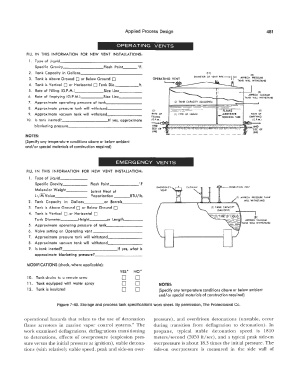
                         Figure 7-40.  Storage and process tank specifications work sheet.  By pennission, The Protectoseal  Co.

           operational  hazards  that relate  to  the  use  of detonation   pressure),  and  overdriven  detonations  (unstable,  occur
           flame  arrestors  in  marine  vapor  control  systems."  The   during  transition  from  deflagration  to  detonation).  In
           work  examined  deflagrations,  deflagrations  transitioning   propane,  typical  stable  detonation  speed  is  1810
           to  detonations,  effects  of overpressure  (explosion  pres-   meters/  second  (5950  ft/  sec), and a  typical  peak  side-on
           sure versus the initial  pressure al ignition), stable detona-   overpressure  is about 18.3  times  the initial  pressure.  The
           tions  (with relatively  stable speed, peak  and side-on over-   side-on  overpressure  is  measured  in  the  side  wall  of

