


Page 532 - APPLIED PROCESS DESIGN FOR CHEMICAL AND PETROCHEMICAL PLANTS, Volume 1, 3rd Edition
P. 532
498                       Applied Process Design for Chemical and Petrochemical Plants

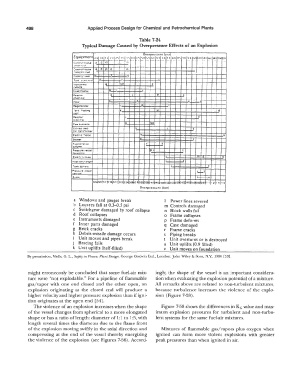
                                                            Table 7-24
                                    Typical Damage Caused by Overpressure Effects of an Explosion

                                                             Uvmprit ,'i1Hf!  lp�1)
                                                                  1
                                                 ._.__
                                Equipment  ,, s  Ill  1' ll)  /', � Jl"l'1  ,11)  ,,.,  110  !-,  �  t,()  I)!,  II)  l!t  "o n �  •  '.JCJ  '.J!,U,I  1]1 114(  lhlhHC  1()( '>}I
                                                                                ...  ..
                                                      -  .
                                                                            -·
                                C11r,1rr,1  h•i.o .. .,  .,  c   ti   11               ·-  --  -I--·  -
                                -.,�ttl  ,,,,,t   a  ..   I   + ..   ,__
                                Conltf)I "'m"""   fl  ti   I
                                r:11nr:,�1· ,r,ol
                                Cor,hnr1  •,)w.,,  ·�   I   ()
                                T.ink  r.r,""  rr,HI   ti   .  le   u
                                ln�tu,rr�I   a     !Im           I
                                cuh1Cl1t
                                Fued  .,,..,.,,   g_  .... ,   t
                                Reactor         a   I    i         p          I
                                che1T11ca1         I
                                F,lter         h           f                    v  -  -t
                                R19t"nen110t        I                   t
                                hrk.  f1011.nq      k              u                         d
                                rcct                                                  I
                                Reacto,.              i                              t
                                cracimq
                                P,oe  sui::oorts      p         so
                                Ut.lor,es  eiec-          h            i          t
                                Irie  r,1,,-s'ormer
                                Electric  -ictor            h                 i                v
                                Slower                      10                    t
                                Fr1ctton1t1on                  r     t
                                column
                                Pressure  ·,esseJ               pi            t
                                t,or1zona1
                                S:eaM  tc-e.oe                         i            m  s       v
                                Heat  e .. c ... :1nger                i      t
                                Tank  SP"' e-e                           i           I   t
                                Pressure  .esser                                    i+t
                                .. e,tical
                                Puma                                                i-1--  -V
                                        :>0• oo* 1  !014 �17  0·2 1>2•p2a o J o-J5pJBt>-•1p45P·•a D521>55D59 0·62p65 �B!joeJ)c>g  1·1  1  2  1  • i  1  s
                                                            Overpressure  (bar)
                                a  Windows  and  gauges  break           Power lines severed
                                b  Louvres  fall  at 0.3-0.5 psi      m  Controls  damaged
                                c  Switchgear damaged  by  roof  collapse   n  Block  walls fail
                                d  Roof collapses                     0  Frame  collapses
                                e  Instruments  damaged               p  Frame deforms
                                f  Inner parts damaged                q  Case  damaged
                                g  Brick  cracks                      r  Frame  cracks
                                h  Debris-missile  damage  occurs     s  Piping  breaks
                                  Unit moves  and  pipes  break       t  Unit  overturns or is destroyed
                                J   Bracinc fails                     u  Unit  uplifts (0.9 filled)
                                k  Unit  uplifts  (half-filled)       v  Unit moves on foundation
             By permission, Wells, G.  L., Safety  i11  Process Plant Design.  George Godwin Ltd., London: John Vviley & Sons, N.Y.,  1980  (53).


             might erroneously  be  concluded  that some  fuel-air mix-   ingly,  the  shape  of the vessel  is  an  important considera-
             ture were  "not explodable." For a  pipeline of flammable   tion when evaluating the explosion potential ofa mixture.
             gas/vapor with  one  end  closed  and  the  other  open,  an   All  remarks above are related to non-turbulent mixtures,
             explosion  originating  at  the  closed  end  will  produce  a   because  turbulence  increases  the  violence  of the  explo-
             higher velocity and higher pressure explosion than if igni-   sion  (Figure 7-58).
             tion originates at the open end  [54].
               The violence of an explosion increases when the shape   Figure 7-58 shows the differences in Kc value and max-
             of the vessel changes from spherical  to a more elongated   imum  explosion  pressures  for  turbulent and  non-turbu-
             shape or has a ratio of length:  diameter of 1:1  to 1:5, with   lent systems for the same fuel-air mixtures.
             length  several  times  the diameter due to  the flame front
             of the explosion moving swiftly in the axial direction and   Mixtures  of flammable  gas/vapors  plus  oxygen  when
             compressing  at  the  end  of the vessel  thereby  energizing   ignited  can  form  more  violent  explosions  with  greater
             the violence of the  explosion  (see Figures  7-56). Accord-   peak pressures than when ignited in air.

