


Page 533 - APPLIED PROCESS DESIGN FOR CHEMICAL AND PETROCHEMICAL PLANTS, Volume 1, 3rd Edition
P. 533
Applied Process Design                                     499

                               Table 7-25A                                           Table 7-25B
                  Selected Over-pressure Failure Situations           Physiological Effects of Blast Over-pressures

                                                    Avg Over-            Physiological Effects           Peak Over-
                   Damage Limits:                 pressure (PSI)          of Blast Pressures           pressure  (PSI)
           Crater                                     280        Knock Personnel Down                        1
           Probable Total  Destruction             10 & Above                          {  Threshold          5
           Limit Serious Structural Damage            2.3        Eardrum Rupture         50%                15
           Limit Earth Wave Damage                    1.2                              {  Threshold        30-40
           Limit Minor Structural Damage              0.4        Lung Damage             Severe           80 & up
           Missile Limit                              0.3                              l  !hreshold       100-120
           Typical  Glass Failure                     0.15       Lethality               :>0%             130-180
           Limit Glass Breakage                       0.006                              Near 100%        200-250
           By permission,  Stull  [41] Dow Chemical  Co.  and American  Institute of   By permission,  Stull  [41]  Dow  Chemical  Co.  and American  Institute of
           Chemical  Engineers,  Monograph Series,  No.  10,  V.  73  (1977).   Chemical  Engineers, Monograph.  Series,  No.  10,  V.  73  (1977).

                                                                   100.--��-,.�������...-�--,,,.....-,
                                                                                             ,-----  ----Pm
                                                         45                                  I
                                                         40                 Calculated       I
             3,000                                                       (9-liter sphere)--{
                                                         35
                                                                    80                      I
            ..                                            30                               I
            u
           �  2,500                        Ps  (experimental)   25  !.                     I
                                                            0
            E
           :::                                           20  �-   II)
                                                                  a.
                                                          15
             2,000                                               u.i 60
                                                          10     !!?
                                                                  a::
                                                          5
                                                                 LU
              1,500L----'--�----'---�--..._  __  ..__  _  __, 0   er
                 ro   �     �    �     ro    ro    �    �
                                 Hz  1  volume-  percent         �  40
                                                                  (/)
                                                                 I.LI
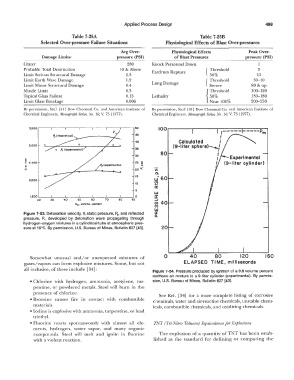
           Figure 7-53. Detonation velocity,  V,  static pressure, P,,, and reflected   tr
                                                                  a.
           pressure,  P,.,  developed  by  detonation  wave  propagating  through
           hydrogen-oxygen mixtures in a cylindrical tube at atmospheric pres-
           sure at 18°C. By permission, U.S. Bureau of Mines, Bulletin 627 [43].   20


              Somewhat  unusual  and/  or  unexpected  mixtures  of   0         40         80        120        160
           gases/vapors  can form explosive mixtures.  Some, but not          ELAPSED  TIME, milliseconds
           all inclusive,  of these include  [34]:               Figure 7-54.  Pressure produced  by ignition of a 9.6 volume percent
                                                                 methane-air mixture  in  a 9-liter cylinder (experimental).  By  permis-
              • Chlorine  with  hydrogen,  ammonia,  acetylene,  tur-   sion,  U.S.  Bureau of Mines,  Bulletin 627  [43].
               pentine,  or powdered  metals.  Steel  will  burn  in  the
               presence of chlorine.                               See  Ref.  [34]  for a  more  complete  listing  of corrosive
              • Bromine  causes  fire  in  contact  with  combustible   chemicals, water and air-reactive chemicals, unstable chem-
               materials.                                        icals,  combustible chemicals, and oxidizing chemicals.
              • Iodine is explosive with ammonia, turpentine, or lead
               triethyl,
              • Fluorine  reacts  spontaneously  with  almost  all  ele-   TNT (Tri-Nitro  Toluene)  Equivalence for Explosions
               ments,  hydrogen,  water  vapor,  and  many  organic
               compounds.  Steel  will  melt  and  ignite  in  fluorine   The explosion  of a  quantity  of TNT has been estab-
               with a violent reaction.                          lished  as  the  standard  for  defining  or  comparing  the

