


Page 572 - APPLIED PROCESS DESIGN FOR CHEMICAL AND PETROCHEMICAL PLANTS, Volume 1, 3rd Edition
P. 572
538                       Applied  Process Design for Chemical  and  Petrochemical  Plants

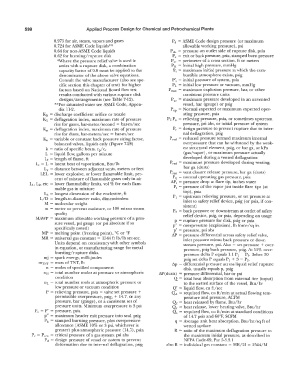
                        0.975 for air,  steam, vapors and gases          Pd  = ASME Code design pressure  ( or maximum
                        0. 724 for ASME Code liquids**                       allowable working pressure), psi
                        0.64 for non-ASME Code liquids                  P  do  =  pressure on outlet side of rupture disk,  psia
                        0.62 for bursting  /rupture disk                 Pe  =  exit or back pressure, psia, stamped burst pressure
                         *Where the pressure relief  valve  is used in   Per  =  perimeter of a cross section, ft or meters
                          series with a rupture disk, a combination      PH  =  Initial high pressure, mmHg
                          capacity factor of 0.8 must be applied to the   P;  =  maximum initial pressure at which the com-
                          denominator of the above valve equations.          bustible atmosphere exists,  psig
                          Consult the valve manufacturer (also see spe-   P\ = initial pressure of system,  psia
                          cific section this chapter of text)  for higher   PL  =  initial  low pressure or vacuum,  mmHg
                          factors based on National  Board flow test   P  max  =  maximum explosion pressure, bar,  or other
                          results conducted with various rupture disk        consistent pressure units
                          designs/arrangements  (see Table 7-12).       Puv  =  maximum pressure developed in an unvented
                        **For saturated water see ASME Code, Appen-          vessel, bar (gauge)  or psig
                          dix 11-2.                                     Pop  = Normal expected or maximum expected oper-
                   K 0  =  discharge coefficient orifice or nozzle           ating pressure, psia
                   Kc  =  deflagration index, maximum  rate of pressure   P;; P O  = relieving pressure, psia, or sometimes upstream
                        rise for gases,  bar-meter  I  second =  bar-m/  sec   pressure,  psi  abs,  or initial pressure of system
                   K.,  =  deflagration index,  maximum rate of pressure   Pr  =  design pressure to prevent rupture due to inter-
                        rise for dusts, bar-meters/  sec  =  bar-m/  sec     nal deflagration, psig
                   I{...  = variable or constant back pressure sizing factor,   P,ed  =  reduced pressure termed maximum internal
                        balanced valves, liquids only (Figure 7-28)          overpressure that can be withstood by the weak-
                    k  =  ratio of specific heats,  cp/  c,                  est structural element,  psig,  or bar ga,  or kPa
                    L  =  liquid flow,  gallons per minute                    (gas/vapor), or maximum pressure actually
                    Lr  =  length of flame, ft                               developed during a vented deflagration
                L_.  =  L  =  latent heat of vaporization, Btu/lb       P,ed  =  maximum pressure developed during venting,
                   L, = distance between adjacent vents,  meters or feet      bar ga  (dusts)
                  LEL  =  lower explosive,  or lower flammable limit,  per-   P,ta,  = vent closure release pressure, bar ga  (dusts)
                        cent of mixture of flammable gases only in air   P 11  =  normal  operating gas pressure,  psia
             L1,  �' etc  =  lower flammability limits, vol %  for each flam-   6P,  =  pressure drop at flare  tip,  inches water
                        mable gas in mixture                             P,  =  pressure of the vapor  just inside flare  tips  (at
                    L3  =  longest dimension of the enclosure, ft             top), psia
                  L/D  =  length-to-diameter ratio, dimensionless        P 1  =  upstream relieving pressure, or set pressure at
                                                                              inlet to safety relief device,  psig  (or psia,  if con-
                    M  =  molecular weight                                    sistent)
                    m  = meter or percent moisture,  or 100 minus steam   P 2  = back pressure or downstream at outlet of safety
                        quality
                                                                              relief device, psig,  or psia,  depending on usage
                MAWP  =  maximum allowable working pressure of a pres-    p  =  rupture pressure for disk,  psig or psia
                        sure vessel, psi gauge  (or psi absolute if so   p"  =  overpressure  (explosion), lb force/sq in.
                        specifically noted)                              p' =  pressure, psi abs
                   MP  =  melting point (freezing point), °C or °F       6P  =  pressure differential across safety relief valve,
                  MR  =  universal gas constant =  1544 ft  lb/lb sec-sec.    inlet pressure minus back pressure or down
                        Units depend on consistency with other symbols        stream pressure,  psi. Also  =  set pressure  +  over-
                        in equation, or manufacturing range for metal         pressure, psig-back pressure,  psig.  At 10%  over-
                        bursting/rupture disks.                               pressure delta P equals 1.1  P1  - P 2.  Below 30
                   mj  =  spark energy,  milli-joules                         psig set delta P  equals P1  +  3  - P2.
                 mn, =  mass of TNT,  lb                                 6p  =  differential  pressure across liquid relief rupture
                    n  =  moles of specified components                       disk,  usually equals p, psig
                   nH  =  total number moles at pressure or atmospheric   6P(dusts)  =  pressure differential, bar or psi
                        condition                                         Q =  total heat absorption from external  fire  (input)
                   nL  =  total number mols at atmospheric pressure or        to the wetted surface of the vessel,  Btu/hr
                        low pressure or vacuum condition                 Q =  liquid flow,  cu ft/sec
                    P  =  relieving pressure,  psia = valve set pressure  +   Q\  =  required flow,  cu ft/min at actual flowing tem-
                        permissible overpressure, psig,  +  14.7, or any      perature and pressure, ACFM
                        pressure, bar (gauge), or a consistent set of    Qr  =  heat released by flame, Btu/hr
                        pressure units.  Minimum  overpressure is 3  psi   Qr  =  heat release,  lower heating valve, Btu/hr
                P1  =  P'  =  pressure,  psia                            Q.,  =  required flow,  cu ft/min at standard conditions
                    p" =  maximum header exit pressure into seal, psig        of 14. 7 psi a and 60°F,  SCFM
                    Pb  =  stamped bursting pressure,  plus overpressure   q  = Average unit heat absorption, Btu/hr/sq ft of
                        allowance  (ASME  10% or 3  psi, whichever is         wetted surface
                        greater)  plus atmospheric pressure  (14.7), psia   R  =  ratio of the maximum deflagration pressure  to
              Pc= Pcrit  =  critical  pressure of a gas system,  psi  abs     the maximum initial pressure,  as described in
                    Pd  =  design  pressure of  vessel  or system to prevent   NFPA Code-69, Par 5-3.3.1
                        deformation due to internal deflagration, psig   also R  =  individual gas constant= MR/M  =  1544/M

