


Page 570 - APPLIED PROCESS DESIGN FOR CHEMICAL AND PETROCHEMICAL PLANTS, Volume 1, 3rd Edition
P. 570
536                       Applied  Process Design for Chemical and Petrochemical  Plants

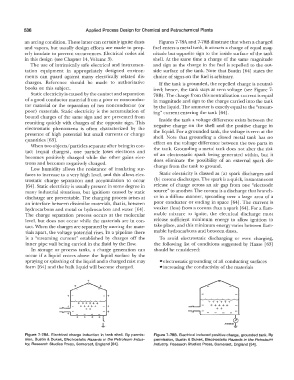
           an arcing condition. These latter can certainly ignite dusts   Figures 7-78A and 7-78B illustrate that when a charged
           and vapors,  but usually  design  efforts  are  made  to  prop-   fuel enters a metal  tank, it attracts a charge of equal mag-
           erly insulate  to  prevent occurrences.  Electrical  codes aid   nitude but opposite sign  to  the inside surface of the tank
           in this design  (see Chapter 14, Volume 3).           shell.  At  the  same  time  a  charge  of the  same  magnitude
              The use  of intrinsically  safe  electrical  and instrumen-   and  sign  as  the charge  in  the  fuel  is  repelled  to  the out-
            tation  equipment  in  appropriately  designed  environ-   side surface of the  tank.  Note  that Bustin  [64]  states  the
            ments  can  guard  against  many  electrically  related  dis-   choice of signs on the fuel is arbitrary.
            charges.  Reference  should  be  made  to  authoritative   If the tank is grounded,  the repelled charge is neutral-
           books on  this subject.                               ized;  hence,  the  tank  stays  at zero  voltage  (see  Figure  7-
              Static electricity is caused by the contact and separation   78B). The charge from this neutralization current is equal
            of a good conductor material  from a poor or nonconduc-   in magnitude and sign to the charge carried into the tank
            tor material  or  the  separation  of two  nonconductor  ( or   by the liquid. The ammeter is exactly equal to the "stream-
            poor)  materials.  Static  electricity  is  the  accumulation  of   ing" current entering the tank  [64].
            bound  charges  of the same sign  and are prevented from   Inside the tank a voltage difference exists between the
            reuniting quickly with  charges  of the opposite sign. This   negative  charge  on  the  shell  and  the  positive  charge  in
            electrostatic  phenomena  is  often  characterized  by  the   the liquid. For a grounded tank,  the voltage is zero at the
            presence  of high  potential  but small  currents  or charge   shell.  Note  that  grounding  a  closed  metal  tank  has  no
            quantities  [63].                                    effect on  the voltage  difference between  the two  parts  in
              When two objects/particles separate after being in con-
                                                                 the  tank.  Grounding a metal  tank does not alter the risk
            tact  ( equal  charges),  one  particle  loses  electrons  and   of an  electrostatic  spark  being  generated  within,  but it
            becomes  positively  charged  while  the  other  gains  elec-
            trons and becomes negatively  charged.               does  eliminate  the  possibility  of an  external  spark  dis-
              Low  humidity  allows  the  resistance  of insulating  sur-   charge from the tank to ground.
            faces to increase to a very high  level, and this allows  elec-   Static  electricity is  classed as  (a)  spark  discharges  and
            trostatic  charge  separation  and  accumulation  to  occur   (b)  corona discharges. The spark is a quick,  instantaneous
            [64]. Static electricity is usually present in some degree in   release  of charge  across  an  air gap  from  one  "electrode
            many  industrial  situations,  but ignitions  caused  by  static   source" to another.  The corona is a discharge that branch-
            discharge  are  preventable.  The charging process  arises at   es  in  a  diffuse  manner,  spreading  over a  large  area  of a
            an interface between dissimilar materials,  that is,  between   poor conductor or ending in  space  [64]. The  current is
            hydrocarbons  and metal  or hydrocarbon  and water  [64].   weaker (less)  from a corona than a spark  [64]. For a flam-
            The  charge  separation  process  occurs  al  the  molecular   mable  mixture  to  ignite,  the  electrical  discharge  must
            level,  but does  not occur while  the  materials  are  in  con-   release  sufficient minimum  energy  to  allow  ignition  to
            tact.  When the charges are separated by moving the mate-   take place, and this minimum energy varies between flam-
            rials apart,  the voltage potential  rises.  In a pipeline  there   mable hydrocarbons and between dusts.
            is  a  "streaming  current"  established  by  charges  off  the   To  avoid  electrostatic  discharging  or  even  charging,
            inner pipe wall being carried in  the fluid by the flow.   the  following list of conditions  suggested  by  Haase  [63]
              In  storage  or  process  tanks,  a  charge  generation  can   should be considered:
            occur  if a  liquid  enters  above  the  liquid  surface  by  the
            spraying or splashing of  the liquid and a charged mist may   • electrostatic grounding of all conducting surfaces
            form  [64]  and the bulk liquid will become charged.    • increasing the conductivity of the materials


                                      +


                             +  -           -  +
                                  ++++++                                                ++++++
                             +-  +++++      -+                                           +++++
                                     ++                                                    ++
                                            - +
                             +  '---,+-....,.+-..,..+-+,.......�


            Figure  7-78A.  Electrical  charge  induction  in  tank shell.  By  permis-   Figure 7-788. Electrical  induced positive charge,  grounded tank. By
           sion,  Bustin & Dukek,  Electrostatic Hazards in the Petroleum Indus-   permission,  Bustin & Dukek,  Electrostatic Hazards in the Petroleum
           try;  Research Studies Press,  Somerset,  England  [64].   Industry;  Research Studies Press, Somerset,  England [64].

