


Page 352 - Basic Japanese
P. 352
7.8. Alternative questions


                An alternative question is one in which you give the listener

                two  or  more  choices  for  an  answer:  Kuruma  de  ikimashita  ka,

                basu de ikimashita ka, chikatetsu de ikimashita ka? ‘Did you go by
                car, or by bus, or by subway?’ In answer to such a question,

                the  listener  picks  out  the  appropriate  alternative  and
                replies, perhaps, Chikatetsu de ikimashita ‘I went by subway.’ If

                the  inquirer  has  omitted  the  correct  alternative  in  his
                question,  the  person  answering  may  say  something  like
                Chigaimasu—densha de ikimashita ‘It’s different (from all those)—

                I went by train.’ Chigau is a verb meaning ‘is different.’ The

                expression  chigaimasu  is  often  used  with  about  the  same
                meaning as sō ja arimasen to inform a person he is mistaken

                in his assumptions. Do not confuse this verb with the related

                verb  machi-gaeru  ‘makes  a  mistake.’  Chigaimashita  means  ‘it
                was  different  (than  someone  assumed)’;  machigaemashita

                means ‘I (or he) made a mistake.’
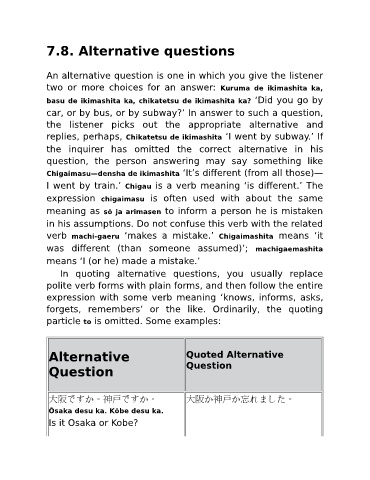
                     In  quoting  alternative  questions,  you  usually  replace

                polite verb forms with plain forms, and then follow the entire
                expression with some verb meaning ‘knows, informs, asks,

                forgets,  remembers’  or  the  like.  Ordinarily,  the  quoting
                particle to is omitted. Some examples:


                 Alternative                                   Quoted Alternative

                 Question                                      Question


                 大阪ですか。神戸ですか。                                  大阪か神戸か忘れました。

                 Ōsaka desu ka. Kōbe desu ka.
                 Is it Osaka or Kobe?

