


Page 354 - Basic Japanese
P. 354
Sometimes Japanese add the expression sore to mo ‘(also

                with  that  =)  or  else’  like  an  adverb  before  the  last
                alternative suggested in an alternative question:


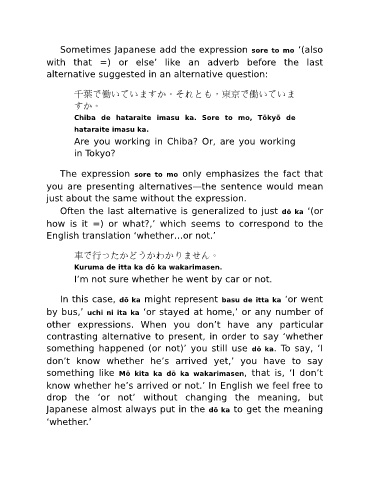
                          千葉で働いていますか。それとも,東京で働いていま

                          すか。

                          Chiba  de  hataraite  imasu  ka.  Sore  to  mo,  Tōkyō  de
                          hataraite imasu ka.
                          Are you working in Chiba? Or, are you working
                          in Tokyo?


                     The expression  sore  to  mo only emphasizes the fact that
                you are presenting alternatives—the sentence would mean

                just about the same without the expression.
                     Often the last alternative is generalized to just dō ka ‘(or

                how  is  it  =)  or  what?,’  which  seems  to  correspond  to  the

                English translation ‘whether…or not.’


                          車で行ったかどうかわかりません。
                          Kuruma de itta ka dō ka wakarimasen.
                          I’m not sure whether he went by car or not.


                     In this case, dō ka might represent basu de itta ka ‘or went
                by bus,’ uchi ni ita ka ‘or stayed at home,’ or any number of

                other  expressions.  When  you  don’t  have  any  particular
                contrasting alternative to present, in order to say ‘whether

                something happened (or not)’ you still use  dō ka. To say, ‘I
                don’t  know  whether  he’s  arrived  yet,’  you  have  to  say

                something  like  Mō  kita  ka  dō  ka  wakarimasen,  that  is,  ‘I  don’t
                know whether he’s arrived or not.’ In English we feel free to

                drop  the  ‘or  not’  without  changing  the  meaning,  but
                Japanese almost always put in the dō ka to get the meaning

                ‘whether.’

