


Page 349 - Basic Japanese
P. 349
verbs  (tabe,  ne,  mi)  and  in  -i  for  consonant  verbs  (kaeri,

                hanashi,  oyogi,  kaki)  and  irregular  verbs  (ki,  shi).  To  this
                infinitive form you add the ending -tai. The resulting form is

                called a “desiderative” or “desiderative adjective,” because

                it means something is desired to be done.
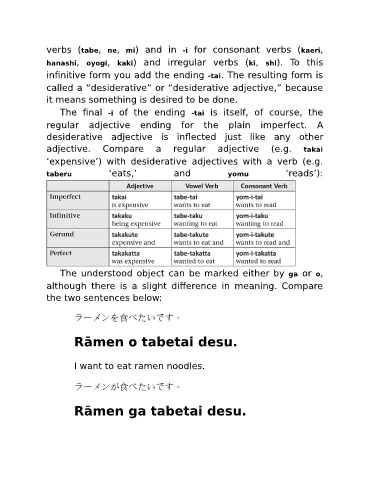
                     The  final  -i  of  the  ending  -tai  is  itself,  of  course,  the

                regular  adjective  ending  for  the  plain  imperfect.  A
                desiderative  adjective  is  inflected  just  like  any  other

                adjective.  Compare                  a  regular  adjective  (e.g.                    takai
                ‘expensive’)  with  desiderative  adjectives  with  a  verb  (e.g.

                taberu               ‘eats,’               and              yomu                ‘reads’):


                     The understood object can be marked either by  ga or  o,

                although  there  is  a  slight  difference  in  meaning.  Compare
                the two sentences below:


                          ラーメンを食べたいです。


                          Rāmen o tabetai desu.


                          I want to eat ramen noodles.


                          ラーメンが食べたいです。


                          Rāmen ga tabetai desu.

