


Page 350 - Basic Japanese
P. 350
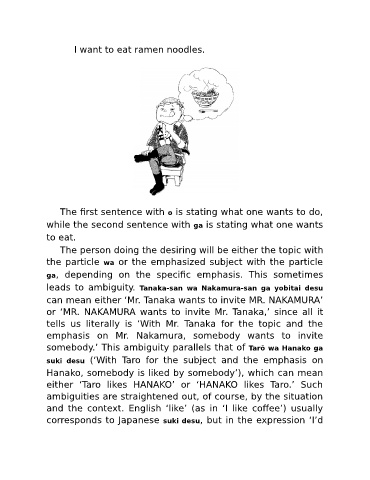
I want to eat ramen noodles.


                     The first sentence with o is stating what one wants to do,
                while the second sentence with ga is stating what one wants

                to eat.
                     The person doing the desiring will be either the topic with

                the particle  wa or the emphasized subject with the particle

                ga,  depending  on  the  specific  emphasis.  This  sometimes

                leads to ambiguity.  Tanaka-san  wa  Nakamura-san  ga  yobitai  desu
                can mean either ‘Mr. Tanaka wants to invite MR. NAKAMURA’
                or  ‘MR.  NAKAMURA  wants  to  invite  Mr.  Tanaka,’  since  all  it

                tells  us  literally  is  ‘With  Mr.  Tanaka  for  the  topic  and  the
                emphasis  on  Mr.  Nakamura,  somebody  wants  to  invite

                somebody.’ This ambiguity parallels that of Tarō wa Hanako ga
                suki  desu  (‘With  Taro  for  the  subject  and  the  emphasis  on

                Hanako, somebody is liked by somebody’), which can mean
                either  ‘Taro  likes  HANAKO’  or  ‘HANAKO  likes  Taro.’  Such

                ambiguities are straightened out, of course, by the situation
                and  the  context.  English  ‘like’  (as  in  ‘I  like  coffee’)  usually

                corresponds to Japanese suki desu, but in the expression ‘I’d

