


Page 415 - Basic Japanese
P. 415
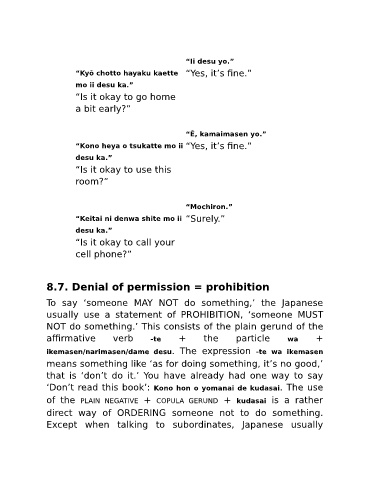
“Ii desu yo.”
                          “Kyō chotto hayaku kaette “Yes, it’s fine.”

                          mo ii desu ka.”
                          “Is it okay to go home
                          a bit early?”


                                                              “Ē, kamaimasen yo.”
                          “Kono heya o tsukatte mo ii “Yes, it’s fine.”

                          desu ka.”
                          “Is it okay to use this
                          room?”


                                                              “Mochiron.”
                          “Keitai ni denwa shite mo ii “Surely.”

                          desu ka.”
                          “Is it okay to call your
                          cell phone?”


                8.7. Denial of permission = prohibition

                To  say  ‘someone  MAY  NOT  do  something,’  the  Japanese

                usually  use  a  statement  of  PROHIBITION,  ‘someone  MUST
                NOT do something.’ This consists of the plain gerund of the

                affirmative             verb         -te      +       the        particle         wa       +

                ikemasen/narimasen/dame  desu.  The  expression  -te  wa  ikemasen
                means something like ‘as for doing something, it’s no good,’
                that  is  ‘don’t  do  it.’  You  have  already  had  one  way  to  say

                ‘Don’t read this book’: Kono hon o yomanai de kudasai. The use
                of  the  PLAIN  NEGATIVE  +  COPULA  GERUND  +  kudasai  is  a  rather

                direct  way  of  ORDERING  someone  not  to  do  something.
                Except  when  talking  to  subordinates,  Japanese  usually

