


Page 86 - Xanathar's Guide To Everything
P. 86
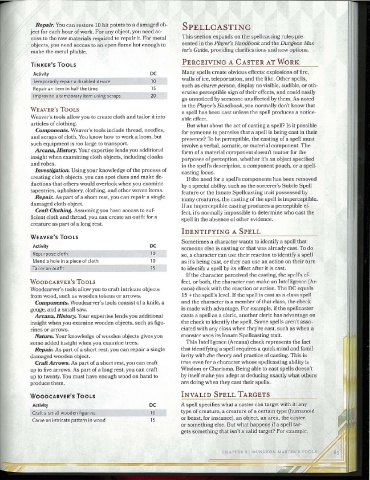
Repair. You can restore 10 hit points to a damaged ob—  SPELLCASTING
           ject for each hour of work. For any object, you need ac-
           cess to the raw materials required to repair it. For metal  This section expands on the spellcasting rules pre—
           objects, you need access to an open flame hot enough to  sented in the Player's Handbook and the Dungeon Mas-
           make the metal pliable.                           ter’s Guide, providing clarifications and new Options.
                                                             PERCEIVING A CASTER AT WORK
           TINKER’s TOOLs
            Activity                               DC        Many spells create obvious effects: explosions of fire,
            Temporarily repair a disabled device   10        walls of ice, teleportation, and the like. Other spells,
            Repair an item in halfthe time         l5        such as charm person, display no visible, audible, or oth—
                                                             erwise perceptible sign of their effects, and could easily
            Improvise a temporary item using scraps  20
                                                             go unnoticed by someone unaffected by them. As noted
                                                             in the Player’s Handbook, you normally don’t know that
           Waxvsa‘s TOOLS                                    a spell has been cast unless the spell produces a notice-
           Weaver‘s tools allow you to create cloth and tailor it into  able effect.
           articles of clothing.                               But what about the act of casting a spell? Is it possible
             Components. Weaver’s tools include thread, needles,  for someOne to perceive that a spell is being cast in their
           and scraps of cloth. You know how to work a loom, but  presence? To be perceptible, the casting of a spell must
           such equipment is too large to transport.         involve a verbal, somatic, or material component. The
             Arcana, History. Your expertise lends you additional  form of a material component doesn’t matter for the
           insight when examining cloth objects, including cloaks  purposes of perception, whether it’s an object specified
           and robes.                                        in the spell’s description, a component pouch, or a spell-
             Investigation. Using your knowledge of the process of  casting focus.
           creating cloth objects, you can spot clues and make de-  If the need for a spell’s components has been removed
           ductions that others would overlook when you examine  by a special ability, such as the sorcerer’s Subtle Spell
           tapestries, upholstery, clothing, and other woven items.  feature or the Innate Spellcasting trait possessed by
             Repair. As part of a short rest, you can repair a single  many creatures, the casting of the spell is imperceptible.
           damaged cloth object.                             If an imperceptible casting produces a perceptible ef-
             Craft Clothing. Assuming you have access to suf—  fect, it’s normally impossible to determine who cast the
           ficient cloth and thread, you can create an outfit for a  spell in the absence of other evidence.
           creature as part of a long rest.
                                                             IDENTIFYING A SPELL
           WEMER’S TOOLS
                                                             Sometimes a character wants to identify a spell that
            Activity                               DC        someone else is casting or that was already cast. To do
            Repurpose cloth                        l0        so, a character can use their reaction to identify a spell
            Mend a hole in a piece ofcloth         l0        as it’s being cast, or they can use an action on their turn
            Tailor an outfit                        15        to identify a spell by its effect after it is cast.
                                                               If the character perceived the casting, the spell’s ef—
           Wooncxavsa’s TOOLS                                fect, or both, the character can make an Intelligence (Ar-
           Woodcarver’s tools allow you to craft intricate objects  cana) check with the reaction or action. The DC equals
           from wood, such as wooden tokens or arrows.       15 + the spell’s level. If the spell is cast as a class spell
             Components. Woodcarver’s tools consist of a knife, a  and the character is a member of that class, the check
           gouge, and a small saw.                           is made with advantage. For example, if the spellcaster
             Arcana, History. Your expertise lends you additional  casts a spell as a cleric, another cleric has advantage on
           insight when you examine wooden objects, such as figu-  the check to identify the spell. Some spells aren't asso—
           rines or arrows.                                  ciated with any class when they’re cast, such as when a
             Nature. Your knowledge of wooden objects gives you  monster uses its Innate Spellcasting trait.
           some added insight when you examine trees.          This Intelligence (Arcana) Check represents the fact
             Repair. As part of a short rest, you can repair a single  that identifying a spell requires a quick mind and famil-
           damaged wooden object.                            iarity with the theory and practice of casting. This is
             Craft Arrows. As part of a short rest, you can craft  true even for a character whose spellcasting ability is
           up to five arrows. As part of a long rest, you can craft  Wisdom or Charisma. Being able to cast spells doesn’t
           up to twenty. You must have enough wood on hand to  by itself make you adept at deducing exactly what others
           produce them.                                     are doing when they cast their spells.

           WOODCARVER’S TOOLS                                INVALID SPELL TARGETS
            Activity                              DC         A spell specifies what a caster can target with it: any
            Craft a small wooden figurine           lO        type of creature, a creature of a certain type (humanoid
            Carve an intricate pattern in wood     l5        or beast, for instance), an object, an area, the caster,
                                                             or something else. But what happens if a spell tar-
                                                             gets something that isn’t a valid target? For example,


                                                                                              :. .'§"j_-_,"_*‘,'~;  if)”. ';.-1 ‘3

