


Page 87 - Xanathar's Guide To Everything
P. 87
someone might cast charm person on a creature be-
                  lieved to be a humanoid, not knowing that the target is
                  in fact a vampire. If this issue comes up, handle it using
                  the following rule.
                    If you cast a spell on someone or something that can’t
                  be affected by the spell, nothing happens to that target,
                  but if you used a spell slot to cast the spell, the slot is  ..  "i
                  still expended. If the spell normally has no effect on a  ”is.  - .-                            ”“7:
                  target that succeeds on a saving throw, the invalid target  '  .  .
                  appears to have succeeded on its saving throw, even
                  though it didn’t attempt one (giving no hint that the crea-
                  ture is in fact an invalid target). Otherwise, you perceive
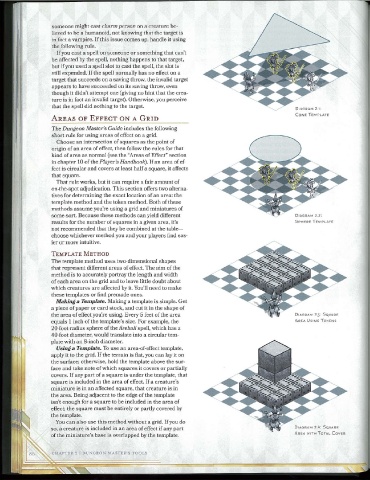
                  that the spell did nothing to the target.                                        DIAGRAM 2,1:

                  AREAS OF EFFECT ON A GRID                                                        CONE TEMPLATE
                  The Dungeon Master’s Guide includes the following
                  short rule for using areas of effect on a grid.
                    Choose an intersection of squares as the point of
                  origin of an area of effect, then follow the rules for that
                  kind of area as normal (see the “Areas of Effect" section
                  in chapter 10 of the Player’s Handbook). If an area of ef—
                  fect is circular and covers at least half a aware, it affects  ,  _
                  that square.                                             I'
                    That rule works, but it can require a fair amount of
                  on-the-spot adjudication. This section offers two alterna-
                  tives for determining the exact location of an area: the
                  template method and the token method. Both of these
                  methods assume you’re using a grid and miniatures of
                  some sort. Because these methods can yield different                             DIAGRAM 2.2:
                  results for the number of squares in a given area, it’s                          SPHERE TEMPLATE
                  not recommended that they be combined at the table—
                  choose whichever method you and your players find eas-
                  ier or more intuitive.
                  TEMPLATE METHOD
                  The template method uses two—dimensional shapes
                  that represent different areas of effect. The aim of the
                  method is to accurately portray the length and width
                  of each area on the grid and to leave little doubt about
                  which creatures are affected by it. You’ll need to make
                  these templates or find premade ones.
                    Making a Template. Making a template is simple. Get
                  a piece of paper or card stock, and cut it in the shape of
                  the area of effect you’re using. Every 5 feet of the area                  _     DIAGRAM 2.3: SQUARE
                  equals 1 inch of the template’s size. For example, the                           ARM US‘NG TOHENS
                  20-foot—radius sphere of the fireball spell, which has a
                  40—foot diameter, would translate into a circular tem—
                  plate with an 8-inch diameter.
                    Using a Template. To use an area-of—effect template,
                  apply it to the grid. If the terrain is flat, you can lay it on
                  the surface; otherwise, hold the template above the sur-
                  face and take note of which squares it covers or partially
                  covers. If any part of a square is under the template, that
                  square is included in the area of effect. If a creature’s
                  miniature is in an affected square, that creature is in
                  the area. Being adjacent to the edge of the template
                  isn't enough for a square to be included in the area of
                  effect; the square must be entirely or partly covered by
                  the template.
                   You can also use this method without a grid. If you do
                  so, a creature is included in an area of effect if any part                     Dmennm 21:: Somme
                  of the miniature’s base is overlapped by the template.                          AREA WITH TOTAL Covert


                  till \i"i'l-'.':=’. '.' i  DUNDEE)“;  t-.i.-\L‘5"i'-'Li-i':"i 'i't'iJCilH

