


Page 89 - Xanathar's Guide To Everything
P. 89
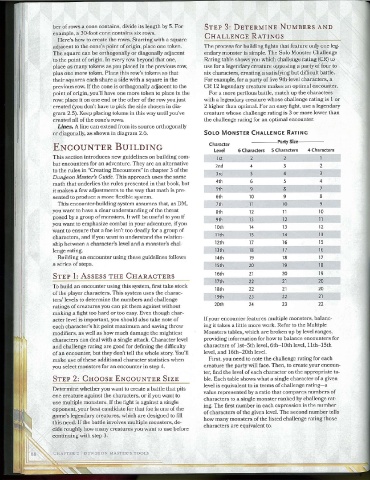
ber of rows a cone contains, divide its length by 5. For  STEP 3: DETERMINE NUMBERS AND
                   example, a 30-foot cone contains six rows.
                    Here’s how to create the rows. Starting with a square  CHALLENGE RATINGS
                   adjacent to the cone’s point of origin, place one token.  The process for building fights that feature only one leg-
                   The square can be orthogonally or diagonally adjacent  endary monster is simple. The Solo Monster Challenge
                   to the point of origin. In every row beyond that one,  Rating table shows you which challenge rating (CR) to
                   place as many tokens as you placed in the previous row,  use for a legendary creature opposing a party of four to
                   plus one more token. Place this row’s tokens so that  six characters, creating a satisfying but difficult battle.
                   their squares each share a side with a square in the  For example, for a party of five 9th~level characters, a
                   previous row. If the cone is orthogonally adjacent to the  CR 12 legendary creature makes an optimal encounter.
                   point of origin, you’ll have one more token to place in the  For a more perilous battle, match up the characters
                   row; place it on one end or the other of the row you just  with a legendary creature whose challenge rating is 1 or
                   created (you don’t have to pick the side chosen in dia—  2 higher than optimal. For an easy fight, use a legendary
                   gram 2.5). Keep placing tokens in this way until you’ve  creature whose challenge rating is 3 or more lower than
                   created all of the cone’s rows.                  the challenge rating for an optimal encounter.
                    Lines. A line can extend from its source orthogonally
                   or diagonally, as shown in diagram 2.6.           SOLo MONSTER CHALLENGE RATlNG
                                                                                             Party Size—
                   ENCOUNTER BUILDING                                 Character  6 Characters  5 Characters  4 Characters
                                                                        Level
                  This section introduces new guidelines on building com-  lst      2          2           1
                  bat encounters for an adventure. They are an alternative  2nd     4          3           2
                  to the rules in “Creating Encounters” in chapter 3 of the  3rd    5          4           3
                  Dungeon Master’s Guide. This approach uses the same
                   math that underlies the rules presented in that book, but  4th   6          5           4
                  it makes a few adjustments to the way that math is pre-  5th      9          8           7’
                  sented to produce a more flexible system.             6th        10          9           8
                    This encounter—building system assumes that, as DM,  7th       11         1O           9
                  you want to have a clear understanding Of the threat  8th        12         11          10
                  posed by a group Of monsters. It will be useful to you if  9th   13         12          11
                  you want to emphasize combat in your adventure, ifyou
                  want to ensure that a foe isn't tOO deadly for a group Of  10th  14         13          12
                  characters, and if you want to understand the relation-  11th    15         14          13
                  ship between a character’s level and a monster’s chal-  12th     17         16          15
                   lenge rating.                                        13th       13         1?          16
                    Building an encounter using these guidelines follows  14th     19         18          17
                  a series of steps.                                    15th       20         19          13
                   STEP 1: ASSESS THE CHARACTERS                        16th       21         20          19
                                                                        17th       22         21          20
                  To build an encounter using this system, first take stock                    21          20
                  of the player characters. "This system uses the charac-  18th    22
                  ters’ levels to determine the numbers and challenge   19th       23         22          21
                  ratings of creatures you can pit them against Without  20th      24         23          22
                  making a fight too hard or too easy. Even though char-
                  acter level is important, you should also take note Of  If your encounter features multiple monsters, balanc-
                  each character’s hit point maximum and saving throw  ing it takes a little more work. Refer to the Multiple
                  modifiers, as well as how much damage the mightiest  Monsters tables, which are broken up by level ranges,
                  characters can deal with a single attack. Character level  providing information for how to balance encounters for
                  and challenge rating are good for defining the difficulty  characters of let—5th level, 6th—10th level, llth—15th
                  of an encounter, but they don't tell the whole story. You’ll  level, and 16th—20th level.
                  make use of these additional character statistics when  First, you need to note the challenge rating for each
                  you select monsters for an encounter in step 4.   creature the party will face. Then, to create your encoun-
                                                                    ter, find the level of each character on the appropriate ta-
                   STEP 2: CHOOSE ENCOUNTER SIZE                    ble. Each table shows what a single character of a given
                  Determine whether you want to create a battle that pits  level is equivalent to in terms of challenge rating—a
                  one creature against the characters, or if you want to  value represented by a ratio that compares numbers of
                                                                    characters to a single monster ranked by challenge rat—
                  use multiple monsters. If the fight is against a single  ing. The first number in each expression is the number
                  opponent, your best candidate for that foe is one of the  of characters of the given level. The second number tells
                  game’s legendary creatures, which are designed to fill  how many monsters of the listed challenge rating those
                  this need. If the battle involves multiple monsters, de—  characters are equivalent to.
                  cide roughly how many creatures you want to use before
                  continuing with step 3.


                   it  “T E' if "2 , ii'r ti  t 3 E f. .3  fr?  5-4": L- }? '  i ll H118

