


Page 92 - Xanathar's Guide To Everything
P. 92
MONSTER PERSONALITY                               RANDOM EVENTS
            To address the question of a monster’s personality, you  Consider what might happen in an encounter area if the
            can use the tables in chapter 4 of the Dungeon Master’s  characters were to never enter it. Do the guards serve in
            Guide, use the Monster Personality table below, or sim-  shifts? What other characters or monsters might visit?
            ply jot down a few notes based on a creature’s Monster  Do creatures gather there to eat or gossip? Are there
            Manna} description. During the battle, you can use these  any natural phenomena—such as strong winds, earth
            ideas to inform how you portray the monsters and their  tremors, or rain squalls—that sometimes take place
            actions. To keep things simple, you can assign the same  in the area? Random events can add a fun element of
            personality traits to an entire group of monsters. For ex-  the unexpected to an encounter. Just when you think
            ample, one bandit gang might be an unruly mob of brag—  a fight’s outcome is evident, an unforeseen event can
            garts, while the members of another gang are always on  make things more compelling.
            edge and ready to flee at the first sign of danger.  A number of the tables in the Dungeon Master’s Guide
                                                              can suggest random events. The tables used for encoun—
            MONSTER PERSONALITY                               ter location, weird locales, and wilderness weather in
               d8   Personality                               chapter 5 of that book are a good starting point for out—
               l    Cowardly; looking to surrender            door encounters. The tables in appendix A can be useful
                                                              for indoor and outdoor encounters—especially the tables
               2    Greedy; wants treasure                    for obstacles, traps, and tricks. Finally, consult the ran-
               3    Braggart; makes a show of bravery but runs from  dom encounter tables in the next section of this book for
                    danger                                    inspiration.
               4    Fanatic; ready to die fighting
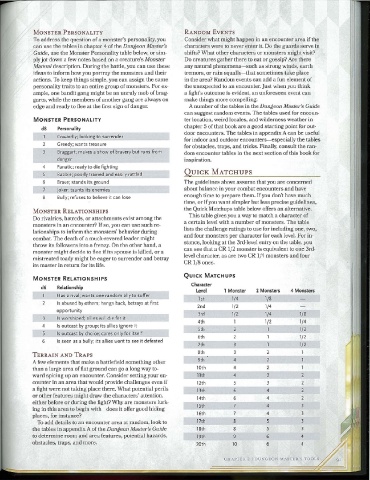
               5    Rabble; poorly trained and easily rattled  QUICK MATCHUPS
               6    Brave; stands its ground                  The guidelines above assume that you are concerned
               7    Joker; taunts its enemies                 about balance in your combat encounters and have
               8    Bully; refuses to believe it can lose     enough time to prepare them. If you don’t have much
                                                              time, or if you want simpler but less precise guidelines,
            MONSTER RELATIONSHIPS                             the Quick Matchups table below offers an alternative.
            Do rivalries, hatreds, or attachments exist among the  This table gives you a way to match a character of
            monsters in an encounter? If so, you can use such re—  a certain level with a number of monsters. The table
            lationships to inform the monsters’ behavior during  lists the challenge ratings to use for including one, two,
            combat. The death of a much—revered leader might  and four monsters per character for each level. For in-
            throw its followers into a frenzy. On the other hand, a  stance, looking at the 3rd-1eve1 entry on the table, you
            monster might decide to flee if its spouse is killed, or a  can see that a CR 1/2- monster is equivalent to one 3rd-
            mistreated toady might be eager to surrender and betray  level character, as are two CR 1/4 monsters and four
            its master in return for its life.                CR 1/8 ones.
                                                              QUICK MATCHUPS
            MONSTER RELATIONSHIPS
               d6   Relationship                                Character  '| Monster  2 Monsters  4 Monsters
                                                                  Level
               1    Has a rival; wants one random ally to suffer   lst        1/4        1/8        -*-
               2    ls abused by others; hangs back, betrays at first  2nd     I/2        1/4        —a
                    opportunity
                    ls worshiped; allies will die for it          3rd         1/2 _.I    1/4        1/8
                                                                                                    1/4
                                                                                         1/2
                                                                  4th
                Chm-hum  Is outcast by group; its allies ignore it  5th                   —l        1/2
                    Is outcast by choice; cares only for itself
                                                                                                    1/2
                                                                  6th
                    ls seen as a bully; its allies want to see it defeated
                                                                  7th                               1/2
            TERRAIN AND TRAPS                                     8th                                —l
            A few elements that make a battlefield something other  9th ‘
            than a large area of flat ground can go a long way to-  10th
            ward spicing up an encounter. Consider setting your en—  llth
            counter in an area that would provide challenges even if  12th     mmmuwmmmbh—bwwmm
            a fight were not taking place there. What potential perils  13th               mmmm—h-h-b-hwwNNN—I—I
            or other features might draw the characters’ attention,
            either before or during the fight? Why are monsters lurk-  14th                           ##WWWWNNMN—‘A
            ing in this area to begin with—does it offer good hiding  15th
            places, for instance?                                 16th
             To add details to an encounter area at random, look to  17th
            the tables in appendix A of the Dungeon Master’s Guide  18th
            to determine room and area features, potential hazards,  19th
            obstacles, traps, and more.                           20th        _I  O


                                                                           tilt-X.“ f'l‘Lil’. '2 | li)l_.'i\i.‘}lft.l.\{ M tfi'l'f'i-i'i‘; 'i'flf'.'?i..‘é  Z.

