


Page 110 - Python Data Science Handbook
P. 110
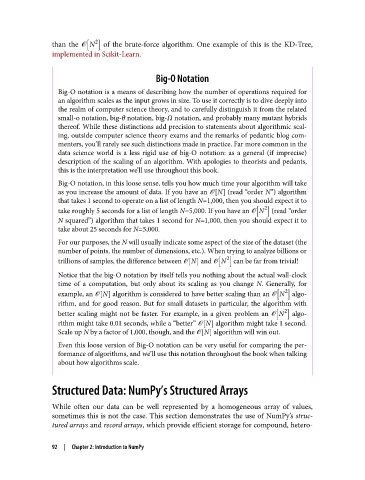
than the ᇭ N 2  of the brute-force algorithm. One example of this is the KD-Tree,
               implemented in Scikit-Learn.


                                            Big-O Notation

                 Big-O notation is a means of describing how the number of operations required for
                 an algorithm scales as the input grows in size. To use it correctly is to dive deeply into
                 the realm of computer science theory, and to carefully distinguish it from the related
                 small-o notation, big-θ notation, big-Ω notation, and probably many mutant hybrids
                 thereof. While these distinctions add precision to statements about algorithmic scal‐
                 ing, outside computer science theory exams and the remarks of pedantic blog com‐
                 menters, you’ll rarely see such distinctions made in practice. Far more common in the
                 data science world is a less rigid use of big-O notation: as a general (if imprecise)
                 description of the scaling of an algorithm. With apologies to theorists and pedants,
                 this is the interpretation we’ll use throughout this book.

                 Big-O notation, in this loose sense, tells you how much time your algorithm will take
                 as you increase the amount of data. If you have an ᇭ N  (read “order N”) algorithm
                 that takes 1 second to operate on a list of length N=1,000, then you should expect it to
                                                                          2
                 take roughly 5 seconds for a list of length N=5,000. If you have an ᇭ N  (read “order
                 N squared”) algorithm that takes 1 second for N=1,000, then you should expect it to
                 take about 25 seconds for N=5,000.
                 For our purposes, the N will usually indicate some aspect of the size of the dataset (the
                 number of points, the number of dimensions, etc.). When trying to analyze billions or
                                                                2
                 trillions of samples, the difference between ᇭ N  and ᇭ N  can be far from trivial!
                 Notice that the big-O notation by itself tells you nothing about the actual wall-clock
                 time of a computation, but only about its scaling as you change N. Generally, for
                                                                                2
                 example, an ᇭ N  algorithm is considered to have better scaling than an ᇭ N  algo‐
                 rithm, and for good reason. But for small datasets in particular, the algorithm with
                 better scaling might not be faster. For example, in a given problem an ᇭ N 2  algo‐
                 rithm might take 0.01 seconds, while a “better” ᇭ N  algorithm might take 1 second.
                 Scale up N by a factor of 1,000, though, and the ᇭ N  algorithm will win out.

                 Even this loose version of Big-O notation can be very useful for comparing the per‐
                 formance of algorithms, and we’ll use this notation throughout the book when talking
                 about how algorithms scale.


               Structured Data: NumPy’s Structured Arrays

               While often our data can be well represented by a homogeneous array of values,
               sometimes this is not the case. This section demonstrates the use of NumPy’s struc‐
               tured arrays and record arrays, which provide efficient storage for compound, hetero‐


               92  |  Chapter 2: Introduction to NumPy

