


Page 107 - Python Data Science Handbook
P. 107
points on a two-dimensional plane. Using the standard convention, we’ll arrange
               these in a 10×2 array:

                   In[14]: X = rand.rand(10, 2)
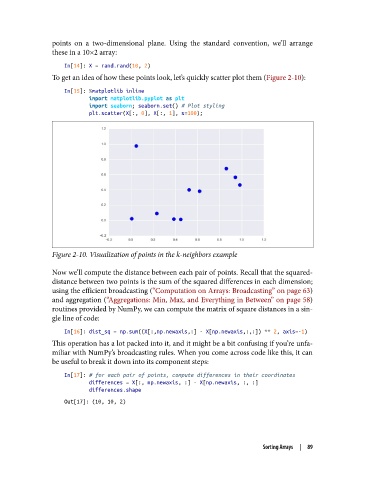
               To get an idea of how these points look, let’s quickly scatter plot them (Figure 2-10):

                   In[15]: %matplotlib inline
                           import matplotlib.pyplot as plt
                           import seaborn; seaborn.set() # Plot styling
                           plt.scatter(X[:, 0], X[:, 1], s=100);


               Figure 2-10. Visualization of points in the k-neighbors example

               Now we’ll compute the distance between each pair of points. Recall that the squared-
               distance between two points is the sum of the squared differences in each dimension;
               using the efficient broadcasting (“Computation on Arrays: Broadcasting” on page 63)
               and aggregation (“Aggregations: Min, Max, and Everything in Between” on page 58)
               routines provided by NumPy, we can compute the matrix of square distances in a sin‐
               gle line of code:
                   In[16]: dist_sq = np.sum((X[:,np.newaxis,:] - X[np.newaxis,:,:]) ** 2, axis=-1)
               This operation has a lot packed into it, and it might be a bit confusing if you’re unfa‐
               miliar with NumPy’s broadcasting rules. When you come across code like this, it can
               be useful to break it down into its component steps:

                   In[17]: # for each pair of points, compute differences in their coordinates
                           differences = X[:, np.newaxis, :] - X[np.newaxis, :, :]
                           differences.shape
                   Out[17]: (10, 10, 2)


                                                                          Sorting Arrays  |  89

