


Page 201 - Python Data Science Handbook
P. 201
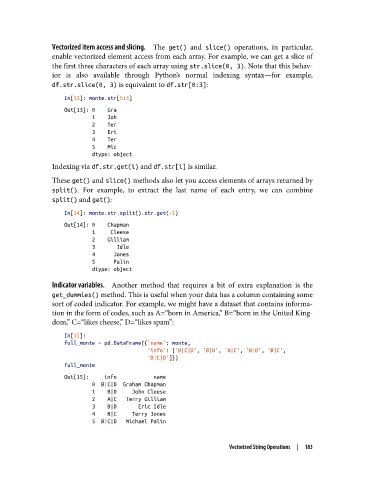
Vectorized item access and slicing.     The get()  and slice()  operations, in particular,
               enable vectorized element access from each array. For example, we can get a slice of
               the first three characters of each array using str.slice(0, 3). Note that this behav‐
               ior is also available through Python’s normal indexing syntax—for example,
               df.str.slice(0, 3) is equivalent to df.str[0:3]:
                   In[13]: monte.str[0:3]
                   Out[13]: 0    Gra
                            1    Joh
                            2    Ter
                            3    Eri
                            4    Ter
                            5    Mic
                            dtype: object
               Indexing via df.str.get(i) and df.str[i] is similar.
               These get() and slice() methods also let you access elements of arrays returned by
               split(). For example, to extract the last name of each entry, we can combine
               split() and get():
                   In[14]: monte.str.split().str.get(-1)
                   Out[14]: 0    Chapman
                            1     Cleese
                            2    Gilliam
                            3       Idle
                            4      Jones
                            5      Palin
                            dtype: object
               Indicator variables.     Another method that requires a bit of extra explanation is the
               get_dummies() method. This is useful when your data has a column containing some
               sort of coded indicator. For example, we might have a dataset that contains informa‐
               tion in the form of codes, such as A=“born in America,” B=“born in the United King‐
               dom,” C=“likes cheese,” D=“likes spam”:
                   In[15]:
                   full_monte = pd.DataFrame({'name': monte,
                                              'info': ['B|C|D', 'B|D', 'A|C', 'B|D', 'B|C',
                                              'B|C|D']})
                   full_monte
                   Out[15]:     info            name
                            0  B|C|D  Graham Chapman
                            1    B|D     John Cleese
                            2    A|C   Terry Gilliam
                            3    B|D       Eric Idle
                            4    B|C     Terry Jones
                            5  B|C|D   Michael Palin


                                                                Vectorized String Operations  |  183

