


Page 203 - Python Data Science Handbook
P. 203
In[19]: with open('recipeitems-latest.json') as f:
                               line = f.readline()
                           pd.read_json(line).shape
                   Out[19]: (2, 12)
               Yes, apparently each line is a valid JSON, so we’ll need to string them together. One
               way we can do this is to actually construct a string representation containing all these
               JSON entries, and then load the whole thing with pd.read_json:

                   In[20]: # read the entire file into a Python array
                           with open('recipeitems-latest.json', 'r') as f:
                               # Extract each line
                               data = (line.strip() for line in f)
                               # Reformat so each line is the element of a list
                               data_json = "[{0}]".format(','.join(data))
                           # read the result as a JSON
                           recipes = pd.read_json(data_json)
                   In[21]: recipes.shape
                   Out[21]: (173278, 17)
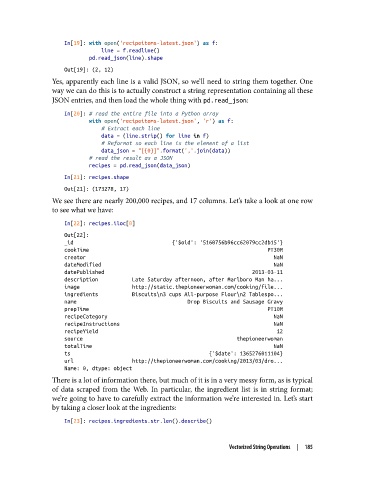
               We see there are nearly 200,000 recipes, and 17 columns. Let’s take a look at one row
               to see what we have:

                   In[22]: recipes.iloc[0]
                   Out[22]:
                   _id                                {'$oid': '5160756b96cc62079cc2db15'}
                   cookTime                                                          PT30M
                   creator                                                             NaN
                   dateModified                                                        NaN
                   datePublished                                                2013-03-11
                   description           Late Saturday afternoon, after Marlboro Man ha...
                   image                 http://static.thepioneerwoman.com/cooking/file...
                   ingredients           Biscuits\n3 cups All-purpose Flour\n2 Tablespo...
                   name                                    Drop Biscuits and Sausage Gravy
                   prepTime                                                          PT10M
                   recipeCategory                                                      NaN
                   recipeInstructions                                                  NaN
                   recipeYield                                                          12
                   source                                                  thepioneerwoman
                   totalTime                                                           NaN
                   ts                                             {'$date': 1365276011104}
                   url                   http://thepioneerwoman.com/cooking/2013/03/dro...
                   Name: 0, dtype: object
               There is a lot of information there, but much of it is in a very messy form, as is typical
               of data scraped from the Web. In particular, the ingredient list is in string format;
               we’re going to have to carefully extract the information we’re interested in. Let’s start
               by taking a closer look at the ingredients:

                   In[23]: recipes.ingredients.str.len().describe()


                                                                Vectorized String Operations  |  185

