


Page 199 - Python Data Science Handbook
P. 199
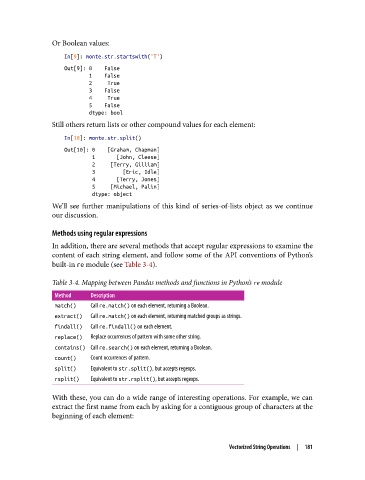
Or Boolean values:

                   In[9]: monte.str.startswith('T')
                   Out[9]: 0    False
                           1    False
                           2     True
                           3    False
                           4     True
                           5    False
                           dtype: bool
               Still others return lists or other compound values for each element:

                   In[10]: monte.str.split()
                   Out[10]: 0    [Graham, Chapman]
                            1       [John, Cleese]
                            2     [Terry, Gilliam]
                            3         [Eric, Idle]
                            4       [Terry, Jones]
                            5     [Michael, Palin]
                            dtype: object
               We’ll see further manipulations of this kind of series-of-lists object as we continue
               our discussion.

               Methods using regular expressions

               In addition, there are several methods that accept regular expressions to examine the
               content of each string element, and follow some of the API conventions of Python’s
               built-in re module (see Table 3-4).

               Table 3-4. Mapping between Pandas methods and functions in Python’s re module
                Method    Description
                match()   Call re.match() on each element, returning a Boolean.
                extract()  Call re.match() on each element, returning matched groups as strings.
                findall()  Call re.findall() on each element.
                replace()  Replace occurrences of pattern with some other string.
                contains() Call re.search() on each element, returning a Boolean.
                count()   Count occurrences of pattern.
                split()   Equivalent to str.split(), but accepts regexps.
                rsplit()  Equivalent to str.rsplit(), but accepts regexps.

               With these, you can do a wide range of interesting operations. For example, we can
               extract the first name from each by asking for a contiguous group of characters at the
               beginning of each element:


                                                                Vectorized String Operations  |  181

