


Page 204 - Python Data Science Handbook
P. 204
Out[23]: count    173278.000000
                            mean        244.617926
                            std         146.705285
                            min           0.000000
                            25%         147.000000
                            50%         221.000000
                            75%         314.000000
                            max        9067.000000
                            Name: ingredients, dtype: float64
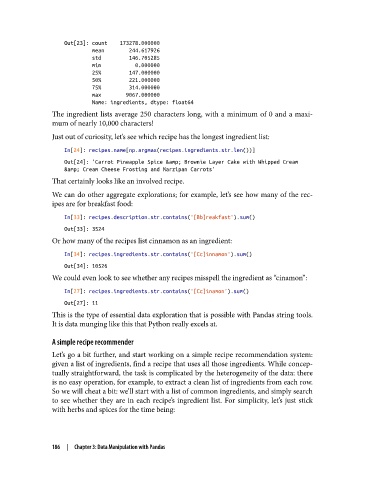
               The ingredient lists average 250 characters long, with a minimum of 0 and a maxi‐
               mum of nearly 10,000 characters!

               Just out of curiosity, let’s see which recipe has the longest ingredient list:
                   In[24]: recipes.name[np.argmax(recipes.ingredients.str.len())]
                   Out[24]: 'Carrot Pineapple Spice & Brownie Layer Cake with Whipped Cream
                   & Cream Cheese Frosting and Marzipan Carrots'
               That certainly looks like an involved recipe.

               We can do other aggregate explorations; for example, let’s see how many of the rec‐
               ipes are for breakfast food:

                   In[33]: recipes.description.str.contains('[Bb]reakfast').sum()
                   Out[33]: 3524
               Or how many of the recipes list cinnamon as an ingredient:
                   In[34]: recipes.ingredients.str.contains('[Cc]innamon').sum()
                   Out[34]: 10526
               We could even look to see whether any recipes misspell the ingredient as “cinamon”:

                   In[27]: recipes.ingredients.str.contains('[Cc]inamon').sum()
                   Out[27]: 11
               This is the type of essential data exploration that is possible with Pandas string tools.
               It is data munging like this that Python really excels at.

               A simple recipe recommender
               Let’s go a bit further, and start working on a simple recipe recommendation system:
               given a list of ingredients, find a recipe that uses all those ingredients. While concep‐
               tually straightforward, the task is complicated by the heterogeneity of the data: there
               is no easy operation, for example, to extract a clean list of ingredients from each row.
               So we will cheat a bit: we’ll start with a list of common ingredients, and simply search
               to see whether they are in each recipe’s ingredient list. For simplicity, let’s just stick
               with herbs and spices for the time being:


               186  |  Chapter 3: Data Manipulation with Pandas

