


Page 200 - Python Data Science Handbook
P. 200
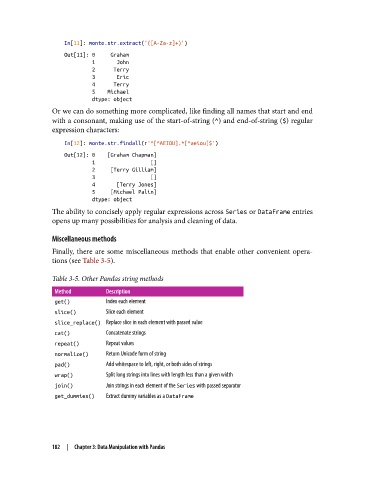
In[11]: monte.str.extract('([A-Za-z]+)')
                   Out[11]: 0     Graham
                            1       John
                            2      Terry
                            3       Eric
                            4      Terry
                            5    Michael
                            dtype: object
               Or we can do something more complicated, like finding all names that start and end
               with a consonant, making use of the start-of-string (^) and end-of-string ($) regular
               expression characters:
                   In[12]: monte.str.findall(r'^[^AEIOU].*[^aeiou]$')
                   Out[12]: 0    [Graham Chapman]
                            1                  []
                            2     [Terry Gilliam]
                            3                  []
                            4       [Terry Jones]
                            5     [Michael Palin]
                            dtype: object
               The ability to concisely apply regular expressions across Series or DataFrame entries
               opens up many possibilities for analysis and cleaning of data.

               Miscellaneous methods
               Finally, there are some miscellaneous methods that enable other convenient opera‐
               tions (see Table 3-5).

               Table 3-5. Other Pandas string methods

                Method        Description
                get()         Index each element
                slice()       Slice each element
                slice_replace() Replace slice in each element with passed value
                cat()         Concatenate strings
                repeat()      Repeat values
                normalize()   Return Unicode form of string
                pad()         Add whitespace to left, right, or both sides of strings
                wrap()        Split long strings into lines with length less than a given width
                join()        Join strings in each element of the Series with passed separator
                get_dummies()  Extract dummy variables as a DataFrame


               182  |  Chapter 3: Data Manipulation with Pandas

