


Page 22 - Python Data Science Handbook
P. 22
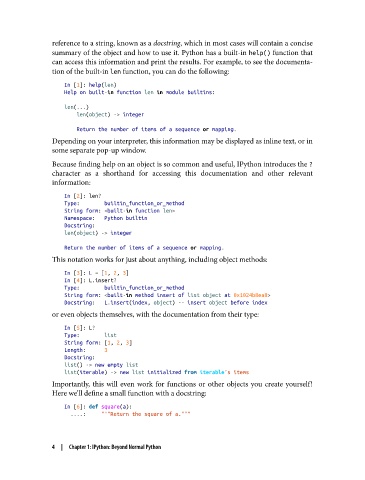
reference to a string, known as a docstring, which in most cases will contain a concise
               summary of the object and how to use it. Python has a built-in help() function that
               can access this information and print the results. For example, to see the documenta‐
               tion of the built-in len function, you can do the following:

                   In [1]: help(len)
                   Help on built-in function len in module builtins:

                   len(...)
                       len(object) -> integer

                       Return the number of items of a sequence or mapping.
               Depending on your interpreter, this information may be displayed as inline text, or in
               some separate pop-up window.

               Because finding help on an object is so common and useful, IPython introduces the ?
               character as a shorthand for accessing this documentation and other relevant
               information:

                   In [2]: len?
                   Type:        builtin_function_or_method
                   String form: <built-in function len>
                   Namespace:   Python builtin
                   Docstring:
                   len(object) -> integer
                   Return the number of items of a sequence or mapping.
               This notation works for just about anything, including object methods:
                   In [3]: L = [1, 2, 3]
                   In [4]: L.insert?
                   Type:        builtin_function_or_method
                   String form: <built-in method insert of list object at 0x1024b8ea8>
                   Docstring:   L.insert(index, object) -- insert object before index
               or even objects themselves, with the documentation from their type:

                   In [5]: L?
                   Type:        list
                   String form: [1, 2, 3]
                   Length:      3
                   Docstring:
                   list() -> new empty list
                   list(iterable) -> new list initialized from iterable's items
               Importantly, this will even work for functions or other objects you create yourself!
               Here we’ll define a small function with a docstring:

                   In [6]: def square(a):
                     ....:     """Return the square of a."""


               4  |  Chapter 1: IPython: Beyond Normal Python

