


Page 25 - Python Data Science Handbook
P. 25
Tab completion when importing

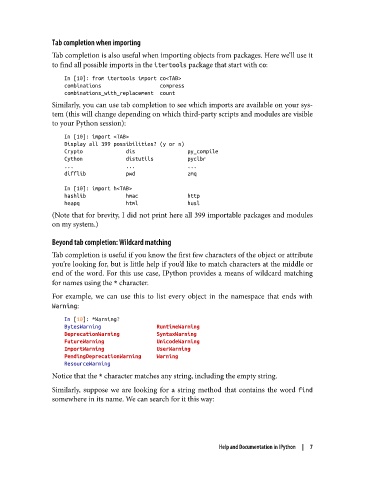
               Tab completion is also useful when importing objects from packages. Here we’ll use it
               to find all possible imports in the itertools package that start with co:

                   In [10]: from itertools import co<TAB>
                   combinations                   compress
                   combinations_with_replacement  count
               Similarly, you can use tab completion to see which imports are available on your sys‐
               tem (this will change depending on which third-party scripts and modules are visible
               to your Python session):

                   In [10]: import <TAB>
                   Display all 399 possibilities? (y or n)
                   Crypto              dis                 py_compile
                   Cython              distutils           pyclbr
                   ...                 ...                 ...
                   difflib             pwd                 zmq

                   In [10]: import h<TAB>
                   hashlib             hmac                http
                   heapq               html                husl
               (Note that for brevity, I did not print here all 399 importable packages and modules
               on my system.)

               Beyond tab completion: Wildcard matching
               Tab completion is useful if you know the first few characters of the object or attribute
               you’re looking for, but is little help if you’d like to match characters at the middle or
               end of the word. For this use case, IPython provides a means of wildcard matching
               for names using the * character.
               For example, we can use this to list every object in the namespace that ends with
               Warning:
                   In [10]: *Warning?
                   BytesWarning                  RuntimeWarning
                   DeprecationWarning            SyntaxWarning
                   FutureWarning                 UnicodeWarning
                   ImportWarning                 UserWarning
                   PendingDeprecationWarning     Warning
                   ResourceWarning
               Notice that the * character matches any string, including the empty string.
               Similarly, suppose we are looking for a string method that contains the word find
               somewhere in its name. We can search for it this way:


                                                              Help and Documentation in IPython  |  7

