


Page 406 - Python Data Science Handbook
P. 406
In order to use this data for machine learning, we need to be able to convert the con‐
               tent of each string into a vector of numbers. For this we will use the TF–IDF vector‐
               izer (discussed in “Feature Engineering” on page 375), and create a pipeline that
               attaches it to a multinomial naive Bayes classifier:

                   In[10]: from sklearn.feature_extraction.text import TfidfVectorizer
                           from sklearn.naive_bayes import MultinomialNB
                           from sklearn.pipeline import make_pipeline

                           model = make_pipeline(TfidfVectorizer(), MultinomialNB())
               With this pipeline, we can apply the model to the training data, and predict labels for
               the test data:

                   In[11]: model.fit(train.data, train.target)
                           labels = model.predict(test.data)
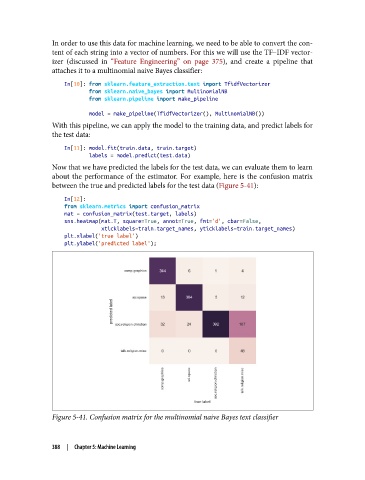
               Now that we have predicted the labels for the test data, we can evaluate them to learn
               about the performance of the estimator. For example, here is the confusion matrix
               between the true and predicted labels for the test data (Figure 5-41):

                   In[12]:
                   from sklearn.metrics import confusion_matrix
                   mat = confusion_matrix(test.target, labels)
                   sns.heatmap(mat.T, square=True, annot=True, fmt='d', cbar=False,
                               xticklabels=train.target_names, yticklabels=train.target_names)
                   plt.xlabel('true label')
                   plt.ylabel('predicted label');


               Figure 5-41. Confusion matrix for the multinomial naive Bayes text classifier


               388  |  Chapter 5: Machine Learning

