


Page 48 - Python Data Science Handbook
P. 48
Filename: ./mprun_demo.py
                   Line #    Mem usage    Increment   Line Contents
                   ================================================
                        4     71.9 MiB      0.0 MiB           L = [j ^ (j >> i) for j in range(N)]


                   Filename: ./mprun_demo.py
                   Line #    Mem usage    Increment   Line Contents
                   ================================================
                        1     39.0 MiB      0.0 MiB   def sum_of_lists(N):
                        2     39.0 MiB      0.0 MiB       total = 0
                        3     46.5 MiB      7.5 MiB       for i in range(5):
                        4     71.9 MiB     25.4 MiB           L = [j ^ (j >> i) for j in range(N)]
                        5     71.9 MiB      0.0 MiB           total += sum(L)
                        6     46.5 MiB    -25.4 MiB           del L # remove reference to L
                        7     39.1 MiB     -7.4 MiB       return total

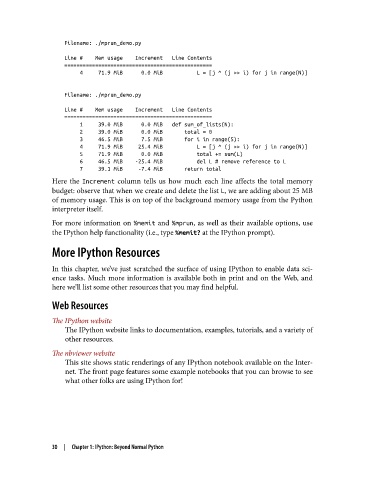
               Here the Increment  column tells us how much each line affects the total memory
               budget: observe that when we create and delete the list L, we are adding about 25 MB
               of memory usage. This is on top of the background memory usage from the Python
               interpreter itself.

               For more information on %memit  and %mprun, as well as their available options, use
               the IPython help functionality (i.e., type %memit? at the IPython prompt).

               More IPython Resources

               In this chapter, we’ve just scratched the surface of using IPython to enable data sci‐
               ence tasks. Much more information is available both in print and on the Web, and
               here we’ll list some other resources that you may find helpful.

               Web Resources

               The IPython website
                   The IPython website links to documentation, examples, tutorials, and a variety of
                   other resources.
               The nbviewer website
                   This site shows static renderings of any IPython notebook available on the Inter‐
                   net. The front page features some example notebooks that you can browse to see
                   what other folks are using IPython for!


               30  |  Chapter 1: IPython: Beyond Normal Python

