


Page 521 - Python Data Science Handbook
P. 521
Parameters
                       ----------
                       bandwidth : float
                           the kernel bandwidth within each class
                       kernel : str
                           the kernel name, passed to KernelDensity
                       """
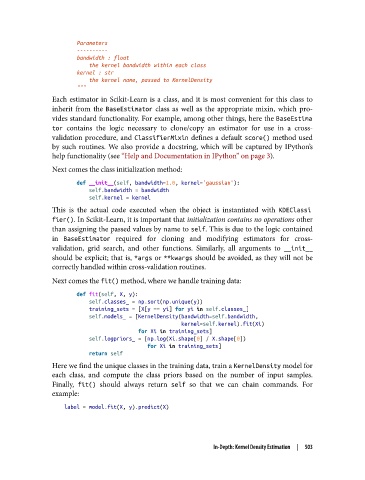
               Each estimator in Scikit-Learn is a class, and it is most convenient for this class to
               inherit from the BaseEstimator  class as well as the appropriate mixin, which pro‐
               vides standard functionality. For example, among other things, here the BaseEstima
               tor  contains the logic necessary to clone/copy an estimator for use in a cross-
               validation procedure, and ClassifierMixin  defines a default score()  method used
               by such routines. We also provide a docstring, which will be captured by IPython’s
               help functionality (see “Help and Documentation in IPython” on page 3).
               Next comes the class initialization method:

                       def __init__(self, bandwidth=1.0, kernel='gaussian'):
                           self.bandwidth = bandwidth
                           self.kernel = kernel
               This is the actual code executed when the object is instantiated with KDEClassi
               fier(). In Scikit-Learn, it is important that initialization contains no operations other
               than assigning the passed values by name to self. This is due to the logic contained
               in BaseEstimator  required for cloning and modifying estimators for cross-
               validation, grid search, and other functions. Similarly, all arguments to __init__
               should be explicit; that is, *args or **kwargs should be avoided, as they will not be
               correctly handled within cross-validation routines.

               Next comes the fit() method, where we handle training data:
                       def fit(self, X, y):
                           self.classes_ = np.sort(np.unique(y))
                           training_sets = [X[y == yi] for yi in self.classes_]
                           self.models_ = [KernelDensity(bandwidth=self.bandwidth,
                                                         kernel=self.kernel).fit(Xi)
                                           for Xi in training_sets]
                           self.logpriors_ = [np.log(Xi.shape[0] / X.shape[0])
                                              for Xi in training_sets]
                           return self
               Here we find the unique classes in the training data, train a KernelDensity model for
               each class, and compute the class priors based on the number of input samples.
               Finally, fit()  should always return self  so that we can chain commands. For
               example:

                   label = model.fit(X, y).predict(X)


                                                            In-Depth: Kernel Density Estimation  |  503

