


Page 517 - Python Data Science Handbook
P. 517
# Get matrices/arrays of species IDs and locations
                           latlon = np.vstack([data.train['dd lat'],
                                               data.train['dd long']]).T
                           species = np.array([d.decode('ascii').startswith('micro')
                                               for d in data.train['species']], dtype='int')
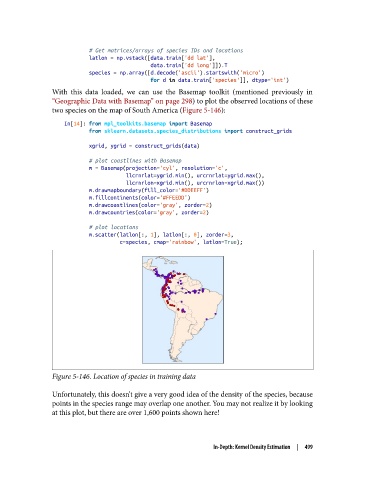
               With this data loaded, we can use the Basemap toolkit (mentioned previously in
               “Geographic Data with Basemap” on page 298) to plot the observed locations of these
               two species on the map of South America (Figure 5-146):

                   In[14]: from mpl_toolkits.basemap import Basemap
                           from sklearn.datasets.species_distributions import construct_grids
                           xgrid, ygrid = construct_grids(data)

                           # plot coastlines with Basemap
                           m = Basemap(projection='cyl', resolution='c',
                                       llcrnrlat=ygrid.min(), urcrnrlat=ygrid.max(),
                                       llcrnrlon=xgrid.min(), urcrnrlon=xgrid.max())
                           m.drawmapboundary(fill_color='#DDEEFF')
                           m.fillcontinents(color='#FFEEDD')
                           m.drawcoastlines(color='gray', zorder=2)
                           m.drawcountries(color='gray', zorder=2)

                           # plot locations
                           m.scatter(latlon[:, 1], latlon[:, 0], zorder=3,
                                     c=species, cmap='rainbow', latlon=True);


               Figure 5-146. Location of species in training data

               Unfortunately, this doesn’t give a very good idea of the density of the species, because
               points in the species range may overlap one another. You may not realize it by looking
               at this plot, but there are over 1,600 points shown here!


                                                            In-Depth: Kernel Density Estimation  |  499

