


Page 519 - Python Data Science Handbook
P. 519
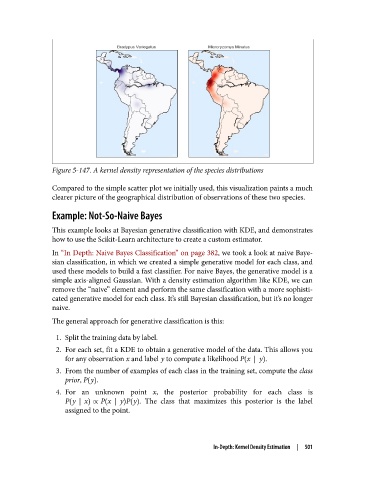
Figure 5-147. A kernel density representation of the species distributions


               Compared to the simple scatter plot we initially used, this visualization paints a much
               clearer picture of the geographical distribution of observations of these two species.

               Example: Not-So-Naive Bayes

               This example looks at Bayesian generative classification with KDE, and demonstrates
               how to use the Scikit-Learn architecture to create a custom estimator.

               In “In Depth: Naive Bayes Classification” on page 382, we took a look at naive Baye‐
               sian classification, in which we created a simple generative model for each class, and
               used these models to build a fast classifier. For naive Bayes, the generative model is a
               simple axis-aligned Gaussian. With a density estimation algorithm like KDE, we can
               remove the “naive” element and perform the same classification with a more sophisti‐
               cated generative model for each class. It’s still Bayesian classification, but it’s no longer
               naive.
               The general approach for generative classification is this:

                1. Split the training data by label.
                2. For each set, fit a KDE to obtain a generative model of the data. This allows you
                   for any observation x and label y to compute a likelihood P x  y .
                3. From the number of examples of each class in the training set, compute the class
                   prior, P y .

                4. For an unknown point x, the posterior probability for each class is
                   P y  x ֣ P x   y P y . The class that maximizes this posterior is the label
                   assigned to the point.


                                                            In-Depth: Kernel Density Estimation  |  501

