


Page 520 - Python Data Science Handbook
P. 520
The algorithm is straightforward and intuitive to understand; the more difficult piece
               is couching it within the Scikit-Learn framework in order to make use of the grid
               search and cross-validation architecture.
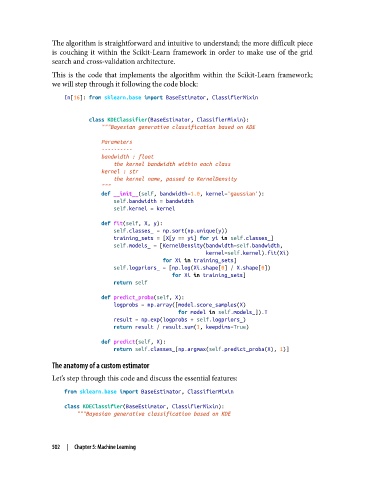
               This is the code that implements the algorithm within the Scikit-Learn framework;
               we will step through it following the code block:
                   In[16]: from sklearn.base import BaseEstimator, ClassifierMixin


                           class KDEClassifier(BaseEstimator, ClassifierMixin):
                               """Bayesian generative classification based on KDE

                               Parameters
                               ----------
                               bandwidth : float
                                   the kernel bandwidth within each class
                               kernel : str
                                   the kernel name, passed to KernelDensity
                               """
                               def __init__(self, bandwidth=1.0, kernel='gaussian'):
                                   self.bandwidth = bandwidth
                                   self.kernel = kernel

                               def fit(self, X, y):
                                   self.classes_ = np.sort(np.unique(y))
                                   training_sets = [X[y == yi] for yi in self.classes_]
                                   self.models_ = [KernelDensity(bandwidth=self.bandwidth,
                                                                 kernel=self.kernel).fit(Xi)
                                                   for Xi in training_sets]
                                   self.logpriors_ = [np.log(Xi.shape[0] / X.shape[0])
                                                      for Xi in training_sets]
                                   return self

                               def predict_proba(self, X):
                                   logprobs = np.array([model.score_samples(X)
                                                        for model in self.models_]).T
                                   result = np.exp(logprobs + self.logpriors_)
                                   return result / result.sum(1, keepdims=True)
                               def predict(self, X):
                                   return self.classes_[np.argmax(self.predict_proba(X), 1)]
               The anatomy of a custom estimator
               Let’s step through this code and discuss the essential features:

                   from sklearn.base import BaseEstimator, ClassifierMixin

                   class KDEClassifier(BaseEstimator, ClassifierMixin):
                       """Bayesian generative classification based on KDE


               502  |  Chapter 5: Machine Learning

