


Page 94 - Python Data Science Handbook
P. 94
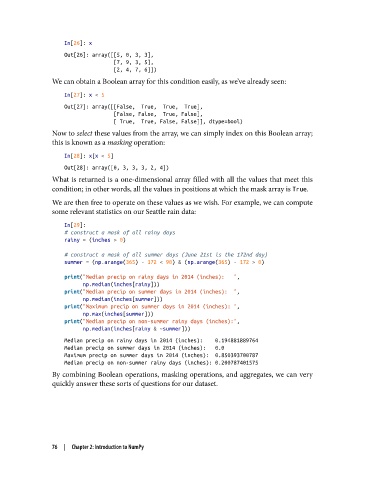
In[26]: x
                   Out[26]: array([[5, 0, 3, 3],
                                   [7, 9, 3, 5],
                                   [2, 4, 7, 6]])
               We can obtain a Boolean array for this condition easily, as we’ve already seen:

                   In[27]: x < 5
                   Out[27]: array([[False,  True,  True,  True],
                                   [False, False,  True, False],
                                   [ True,  True, False, False]], dtype=bool)
               Now to select these values from the array, we can simply index on this Boolean array;
               this is known as a masking operation:
                   In[28]: x[x < 5]
                   Out[28]: array([0, 3, 3, 3, 2, 4])
               What is returned is a one-dimensional array filled with all the values that meet this
               condition; in other words, all the values in positions at which the mask array is True.
               We are then free to operate on these values as we wish. For example, we can compute
               some relevant statistics on our Seattle rain data:
                   In[29]:
                   # construct a mask of all rainy days
                   rainy = (inches > 0)
                   # construct a mask of all summer days (June 21st is the 172nd day)
                   summer = (np.arange(365) - 172 < 90) & (np.arange(365) - 172 > 0)
                   print("Median precip on rainy days in 2014 (inches):   ",
                         np.median(inches[rainy]))
                   print("Median precip on summer days in 2014 (inches):  ",
                         np.median(inches[summer]))
                   print("Maximum precip on summer days in 2014 (inches): ",
                         np.max(inches[summer]))
                   print("Median precip on non-summer rainy days (inches):",
                         np.median(inches[rainy & ~summer]))
                   Median precip on rainy days in 2014 (inches):    0.194881889764
                   Median precip on summer days in 2014 (inches):   0.0
                   Maximum precip on summer days in 2014 (inches):  0.850393700787
                   Median precip on non-summer rainy days (inches): 0.200787401575
               By combining Boolean operations, masking operations, and aggregates, we can very
               quickly answer these sorts of questions for our dataset.


               76  |  Chapter 2: Introduction to NumPy

