


Page 93 - Python Data Science Handbook
P. 93
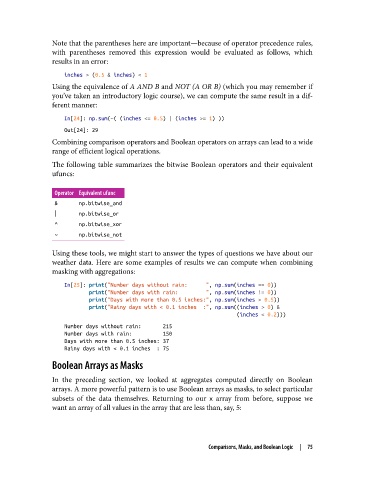
Note that the parentheses here are important—because of operator precedence rules,
               with parentheses removed this expression would be evaluated as follows, which
               results in an error:
                   inches > (0.5 & inches) < 1
               Using the equivalence of A AND B and NOT (A OR B) (which you may remember if
               you’ve taken an introductory logic course), we can compute the same result in a dif‐
               ferent manner:

                   In[24]: np.sum(~( (inches <= 0.5) | (inches >= 1) ))
                   Out[24]: 29
               Combining comparison operators and Boolean operators on arrays can lead to a wide
               range of efficient logical operations.

               The following table summarizes the bitwise Boolean operators and their equivalent
               ufuncs:

                Operator Equivalent ufunc
                &      np.bitwise_and
                |      np.bitwise_or
                ^      np.bitwise_xor
                ~      np.bitwise_not

               Using these tools, we might start to answer the types of questions we have about our
               weather data. Here are some examples of results we can compute when combining
               masking with aggregations:
                   In[25]: print("Number days without rain:      ", np.sum(inches == 0))
                           print("Number days with rain:         ", np.sum(inches != 0))
                           print("Days with more than 0.5 inches:", np.sum(inches > 0.5))
                           print("Rainy days with < 0.1 inches  :", np.sum((inches > 0) &
                                                                           (inches < 0.2)))
                   Number days without rain:       215
                   Number days with rain:          150
                   Days with more than 0.5 inches: 37
                   Rainy days with < 0.1 inches  : 75
               Boolean Arrays as Masks
               In the preceding section, we looked at aggregates computed directly on Boolean
               arrays. A more powerful pattern is to use Boolean arrays as masks, to select particular
               subsets of the data themselves. Returning to our x  array from before, suppose we
               want an array of all values in the array that are less than, say, 5:


                                                           Comparisons, Masks, and Boolean Logic  |  75

